Friday, November 30, 2018

Book review: Every Living Thing by Rob Dunn

I discovered Rob Dunn while researching the Stop Fossil Fuels biological annihilation page. I greatly enjoyed his article on the perhaps foolhardy attempt to estimate the number of global species. His humorous yet informative approach convinced me to read Every Living Thing. The subtitle—Man's Obsessive Quest to Catalog Life, From Nanobacteria to New Monkeys—only superficially summarizes the scope.

The book does indeed portray the work—and, frequently, in laugh-out-loud moments, the quirks—of scientists from Carl Linnaeus to Carl Sagan, with dozens in between. (Including, disproportionately, at least three more "Carls.") But the underlying theme is awe of and love for biological life, in all its frequently unbelievable, unimaginable, and incomprehensible richness.

Dunn zooms from the mostly visible...

There are more species that live with ants; more species in this one obscure relationship than there are bird species. There are hundreds of lifestyles, as strange or stranger than living with ants, that are more common than being a bird, hundreds that are more common than being a vertebrate, for that matter. [...] There are tens of thousands of species of beetles, silverfish, mites, and other invertebrates, not to mention microbes and the occasional ant-following snake that lives with, and only with, ants.

[...]

What Carl and Marian [Rettenmeyer] have discovered, in their years of studying army ants, is not some “big new world of life.” They did not discover microbes or a new kingdom. What they did discover was the intimacy of the interactions of one group of species, the army ants, with others. They discovered these intricate possibilities in the slow way that the morning sun discovers leaves and birds and then finally the forest floor and its interstices.

...to the tiny...

Leeuwenhoek did not know it yet, but this would be the first of hundreds of microscopes he would build and the first of thousands of days he spent looking through them. At night, he would go to sleep seeing microscopic creatures on the backs of his eyelids. He would dream of fleas, ants, and smaller things. His lenses, combined with his abilities to observe and to experiment, were about to open up an entire world of life.

[...]

All along, the biological story had seemed to be about humans, but Leeuwenhoek would show that we were enormous and oversized—the Big Gulps of life. Linnaeus would much later show that there were more big species than had been imagined. But it was Leeuwenhoek who showed that most life was many times smaller than us.

...and ranges more than a mile below the ocean surface, to the deep sea floor in the aftermath of the eruption of a submarine volcano...

As the [submersible] Alvin rounded the hill, the tube worms, crabs, and other life seen in the photos of the site were gone. In their place was a blizzard of white forms, a blizzard, somehow, like the Milky Way. As far into the distance as they could see, the sea was speckled white and the specks were being blasted up in the moving water. [...] [T]he white flocs of the deep sea were produced by bacteria. The blizzard was, in fact, a ninety-foot-tall cloud of bacteria and bacteria excretions. This flowering of life and its products had come out of the cracks and caves in the crust of the Earth through which the magma moved as it had escaped. Life had been coughed in a dense cloud out of the realm of the world once thought lifeless.

...and to outer space. This segment interested me the least, especially phrased as it is with the question (no less insane in its commonness) of "Are humans alone in the universe? Are we the only intelligent life?" This anthropocentrism in a book otherwise enamored with the beings all around us is an ironic, painful juxtaposition. Similarly, some passages are difficult to read as they blithely describe torturous or murderous experiments on living beings, e.g. Terry Erwin's "canopy fogging," a euphemism for applying pesticides to massive tropical trees to wholesale kill and collect tens of thousands of insects. [Part II is, perhaps intentionally, appropriately named for what this culture is doing to the world—"Fogging (The Tree of Life)."]

But besides those occasional glimpses into the sociopathology of the strains of science funded within capitalism, the book is a pleasure to read. I recommend it for anyone biophilic or simply curious about the diverse species with whom we share the earth. Even for those without such interest, the book offers a fascinating dose of humility, an antidote to the ingrained misconception that humans have more-or-less mastered knowledge and control of the planet. We really only know just enough to be dangerous.


On a personal note, this gem may have the longest lasting impact on the story of my own life, as a strong contender for my gravestone epitaph: "Imagine how much less he would have done had he brushed his hair more often."


Table of Contents

    Part I: Beginnings

  1. What we All Used to Know
  2. Common Names
  3. The Invisible World

    Part II: Fogging (The Tree of Life)

  4. The Apostles
  5. Finding Everything
  6. Finding an Ant-Riding Beetle

    Part III: Roots

  7. Diving the Cell
  8. Grafting the Tree of Life
  9. Symbiotic Cells on the Seafloor
  10. Origin Stories

    Part IV: Other Worlds

  11. Looking Out
  12. To Squeeze Life from a Stone
  13. The Wrong Elephant?
  14. What Remains

Rob Dunn has several other titles which promise a similar mix of interesting topics and enjoyable writing:

  • Never home alone: from microbes to millipedes, camel crickets, and honeybees, the natural history of where we live
  • Never out of season: how having the food we want when we want it threatens our food supply and our future
  • The man who touched his own heart: true tales of science, surgery, and mystery
  • The wild life of our bodies: predators, parasites, and partners that shape who we are today

Saturday, October 13, 2018

How many cats to catch 100 rats? Not what you think.

Anthony Doerr's World War II novel All the Light We Cannot See poses the following question in the notebook of Werner Pfennig, a mathematically gifted German boy. Take a couple of minutes to answer the riddle, then expand to read my take.

If five cats catch five rats in five minutes, how many cats are required to catch 100 rats in 100 minutes?

My intuition initially jumped to an answer of "one hundred cats." It feels like a simple scaling: 5 x 5 x 5 to 100 x 100 x 100.

My next instinct was that the answer couldn't be that easy, or there'd be no reason to pose the question. So I applied logical analysis and mathematics to yield an answer of "five cats." Most answers to similar questions on internet sites take the same approach.

However, this conjecture is only accurate if the cats are killing machines, malevolent cousins of the Energizer Bunny, methodically catching rat after rat until their batteries run down. But real cats are individuals with motivations and needs and desires.

So, why do these hypothetical cats want to catch rats?

Cats often stalk and play with mice for practice or for fun, but rats are significantly larger than mice, relatively dangerous prey armed with sharp teeth and claws. Cats usually only take risks with rats in hopes of a substantial meal. In my experience with a sample size of one rat hunter (hi Pookie!), a hungry cat can eat an entire rat in one sitting, then might catch a second rat in the same night, to partially eat or stash for later. I'd guess it rare for a cat to risk catching more than two rats in one hundred minutes.

If five cats catch five rats in five minutes, how many cats with wills of their own are required to catch 100 rats in 100 minutes?

Taking into account what I think I know about cats and their motivations, my answer is "about seventy or eighty cats."

* * *

Our culture turns everyone into numbers, manipulated as variables in equations to maximize profit. Trees older than any human, soaring skyward and spreading a vast canopy sheltering countless individuals of hundreds of species, become board feet. Hens, evolved to scratch and eat seeds and insects while gossiping and squabbling and teaching their chicks to forage, become "layers," their worth measured in eggs deposited from battery cages.

Humans evolved to be nurtured by and in turn contribute back to an intimate community. Human communities evolved to be nurtured by and in turn contribute back to their land bases. In such environments, people fully express their personalities, develop their interests and strengths, and build lives of purpose and responsibility and meaning. In contrast, our culture reduces us to taxpayer IDs, statistics and quotas, interchangeable employees of global systems of extraction and exploitation.

In Nazi Germany, the Jewish men, women, and children in cattle cars were the quintessential abstraction of living beings into numbers, forcibly computed into a final solution. In Doerr's book, even Aryan Germans are valued not as individuals, but because "what the führer really requires is boys. Great rows of them walking to the conveyor belt" as war fodder, "this final harvest of the nation's youth rushing out in a last spasm of futility."

Werner Pfennig, trapped within the Nazi war machine, is repeatedly told "It's only numbers, cadet. Pure math. You have to accustom yourself to thinking that way." But as the story unfolds, abstract numbers wielded in the real world impact real people in devastating, even deadly ways.

Our minds are evolved to form and maintain relationships with a few thousand humans and nonhumans, lifelong family and friends and acquaintances. We can only conceive in abstractions of the 7.6 billion humans and trillions of nonhumans with whom we share the earth. We can't possibly feel the reality of 40.3 million human slaves, 6 million annual deaths from fossil fuel pollution and climate change, 2.4 million children dead from malnutrition, half an acre of natural forest lost every second. In a world globally linked by technology, abstractions are often necessary to grapple with the ethical choices of our time.

But we must never forget that there are lives behind the abstractions. It's not only numbers.

Wednesday, October 03, 2018

Book review: The Overstory by Richard Powers

“The best arguments in the world won’t change a person’s mind. The only thing that can do that is a good story.”

So states one of the nine protagonists of a story good enough to change minds, and perhaps the world as a result. The Overstory weaves the growing science and philosophy of biocentrism with traditional myth and with emerging legends of our digital creations, all illuminated and explored by multiple human narratives. The result offers us a desperately needed alternative path into the future, characterized by relationship rather than exploitation; satisfaction of actual needs rather than endless pursuit of ceaselessly manufactured wants.

Other reviewers (such as Barbara Kingsolver) have extolled the book’s literary merit. As expected from an author with a decades-long string of major awards, Powers’ writing is excellent and engrossing. The story builds slowly as Powers grows its roots one person at a time. The mini-biographies are engaging in and of themselves, but the real payoff comes once they intertwine. It’s difficult for us short-lived humans to understand a time perspective an order of magnitude larger than our own, but the patient arc encompassing multiple generations nudges the reader towards thinking on the scale of forests.

The rise to dominance of our culture has taken place within the lifetime of some trees, the merest blip in planetary history. Our fall will likely occur even faster, as our collective unwillingness to live in relationship with the rest of the world’s inhabitants will doom not only industrialism but hundreds of thousands of species to ruin, leaving the world impoverished for millions of years. Powers sees the insanity of our course clearly. He writes with passion, despair, and anger commensurate to the crisis (albeit leavened by awe for the wonders here now, the possibility of protecting them if we act, and solace in life’s eventual long long long term recovery.)

In many ways this is the antitheses of T.C. Boyle’s A Friend of the Earth. Both books revolve around the practical and moral questions of how to respond appropriately to environmental atrocity after atrocity, with one answer being ecosabotage for planetary self defense. But while Boyle’s book is nihilistic, with unconvincing characters motivated by often petty anthropocentric goals, Powers writes eight realistic journeys of people who come to respect, even love, trees. All make sacrifices for their nonhuman kin, some even risking freedom and their very lives. Several are fully biocentric, recognizing trees as intelligent, communal beings and rejecting the notion of human exceptionalism.

Powers sympathetically portrays the decisions to take underground action, making it easy to understand why the activists in his novel, like those in real life, escalate to illegal tactics. With the system designed to coopt or disempower dissidence, and well practiced at circumventing democratic processes and brutally suppressing protest, anyone wanting to make substantive change is forced outside the box of accepted and expected tactics. Unfortunately, as in A Friend of the Earth, the novel’s ecosabotage is ineffective because it’s limited to a strategy of attrition and doesn’t target critical infrastructure. The eco-fiction genre still needs a story of strategic activists instigating cascading failure by shutting down fossil fuels.

The pursuits of Powers’ protagonists include not just blockades and ecosabotage, but scientific research, art, land restoration, psychology, and harnessing artificial intelligence. Within this diverse tapestry, anyone can find strands which resonate and beckon, inviting the reader to join in the real life struggle with whatever skills and interests he or she can bring. The true measure of The Overstory will not be whether it makes best seller lists or wins critical acclaim and literary awards, but whether it motivates readers to action:

To be human is to confuse a satisfying story with a meaningful one, and to mistake life for something huge with two legs. No: life is mobilized on a vastly larger scale, and the world is failing precisely because no novel can make the contest for the world seem as compelling as the struggles between a few lost people. But Ray needs fiction now as much as anyone. The heroes, villains, and walk-ons his wife gives him this morning are better than truth. Though I am fake, they say, and nothing I do makes the least difference, still, I cross all distances to sit next to you, keep you company, and change your mind.

Perhaps it’s true that even the best arguments won’t change minds. If so, then what we all, human and non-human, need right now is fiction which can. The Overstory may be just that.


Read a long, thoughtful and deep interview with Richard Powers: Here’s to Unsuicide


Review originally published at Stop Fossil Fuels

Saturday, July 14, 2018

Book review: A Friend of the Earth by T.C. Boyle

T.C. Boyle’s A Friend of the Earth could be a fun read for tree huggers and tree spikers alike. In a narrative split between the climate battered world of 2025 and life as a circa 1990 ecosaboteur, environmental doom meets righteously taking on the system. Supporters of Deep Green Resistance, Earth First!, the Earth Liberation Front, or Stop Fossil Fuels are reminded of the climate chaos and mass extinction we’re fighting to head off, and can vicariously (and safely) enjoy the thrill of underground, illegal tactics against a system immune to transformation from within.

The Annoying

The book falls short of its potential, reflecting real life limitations of early (and all too much contemporary) monkeywrencher culture: misogyny and an absence of strategy. This is understandable, since the book was published in 2000 before activist rape culture and toxic male behavior was being called out, and before serious analysis of how to bring down the industrial economy was readily available. If the reader can accept these historic limitations, she can probably still enjoy the book for what it is.

To get past those shortcomings, let’s discuss the negatives first. The protagonist, Ty Tierwater, is 40 and 75 years old in the two narrative time frames. At both ages, he heavily objectifies women, as do most of the other male characters, and he’s obsessed with sex. Maybe this is meant to be cute in a 75 year old man, but is in fact offensive, boring, and distracting in both time periods. Ty mentions many (many) times the large size of his wife Andrea’s breasts (and, oddly, her hands), but at least her personality is also fleshed out in some depth. None of the supporting characters are fully convincing as real people, but Andrea comes as close as anyone. Their daughter is less well developed, but adequately so, and at least she’s subject to less sexual objectification than most of the female characters.

At ages 40 and 75, Ty has the emotional maturity of someone half his ageimpulsive, reckless, alcoholic, bickering, self pitying, jealous, easily distracted by petty revengea case study of someone you don’t want in your underground affinity group. Presumably he’s meant to be an antihero, but his unnecessary misogyny on top of all this moves him to the very margins of being a sympathetic character. (Or perhaps beyond the margins; it’s easy for me as a male to find his woman-hating to be merely annoying, but others may, understandably, give up on the book entirely.)

A Friend of the Earth also suffers from rampant nihilism. The opening torrential rains which will, we’re told, inevitably give way to punishing heat and drought, warn us from the start that the activists’ 1990 efforts to save the world are doomed. Given their absence of strategy, their failure makes sense, but Ty and the book as a whole relish hopelessness, martyrdom, and juvenile lashing out, rather than an adult approach to solving an (admittedly massive) problem. Even Ty’s motivation to protect the earth is more of a passionless “just cause” than the love of someone in relationship with his non-human community members. The book repeatedly depicts humans losing against nature when they stray from the role of subjugator, further undermining the gravity of Ty’s work.

Resignation to failure is understandably common for activists burned out by a failing strategy, but Boyle could choose a different emotional theme. The book hints early on at renewed struggle by the older-yet-wiser activists in the 2025 time frame, with Andrea declaring “Earth Forever! is going to fly again, in a big way.” But Boyle abandons this plot point, instead allowing the book to wallow in despair amidst a broken world. This may realistically depict many one-time activists, but it doesn’t make for a satisfying story. More damningly, it demoralizes rather than inspires readers, including potential activists needed to derail the future Boyle clearly recognizes as a real danger. With the world at stake, using his authorial gifts so perversely is irresponsible.

The Good

The plot moves forward quickly and keeps the reader engrossed. Ty’s irascible narration, though at times over-the-top, generally convincingly portrays a flawed man doing his best to protect the animals he (at least abstractly) loves.

The book excels in its realistic, if unflattering, baring of the failures of the environmental movement. An early nonviolent direct action illustrates the futility of such tactics in the absence of media coverage. The physical danger to the blockaders, unprotected in the absence of witnesses against the sadism of agents of the state, is frighteningly accurate. In the aftermath, Ty and his comrades ratchet up their struggle with tactics straight out of Ecodefense: A Field Guide to Monkeywrenching. (This escalation is appropriate for the environmental movement as a whole, but since Ty and his fellow arrestees are known to the state as aboveground environmentalists, taking up underground action seriously violates the firewall between above- and belowground actionistsa security error all too common among real life activists, even today.)

Ty has some success with his monkeywrenching campaign, wreaking havoc on many earth destroying machines. But as with most real life underground actors in the past decades, he chooses minor targets. Local battles are temporarily won, but the industrial economy at large is allowed to proceed unhindered, and the larger war is therefore lost. Ty exemplifies Lierre Keith’s critique of acting like a vandal rather than thinking like a field general, and the real life experience of busted ecosaboteur Michael Carter around 1990: “We had some vague ideas about tactics but no manual, no concrete theory. […] We had little strategy and the actions were impetuous. If we’d been robbing banks instead, we’d have been shot in the act.” (Carter’s full interview is a fascinating reflection on ecosabotage gone wrong.)

Ty and his comrades belong to Earth Forever!, a conflation (understandable as a simplifying literary device) of Earth First! and Big Green NGOs. Boyle captures well the tension between directly stopping destruction of the land through small scale illegal action, vs garnering donations and political clout by working within the system. (It’s easy to be cynical now about the latter approach, but in 1990 it probably wasn’t as obvious that obediently begging for the scraps of reform dispensed to the well behaved gives no hope of changing the system’s trajectory.)

Since, as in real life, neither Ty nor Earth Forever! act to materially challenge the industrial economy, it falls to an eccentric 2025 pop star, with Ty’s employed help, to play God in deciding which species live or die. As the biblical rains fall and the floodwaters rise, the reader wonders whether they’ll succeed with those animals deemed worthyor perhaps stops caring, with a shrug of “too little too late.”

The Verdict

If you can get past the misogyny, A Friend of the Earth is worth the read. Just be aware that unless your thing is doomer collapsism, you won’t find satisfaction and fulfillment here. A great tale could be spun of ecosaboteurs who bring down the electric grid, halting industrial destruction and proving themselves true friends of the earth. Until then, enjoy T.C. Boyle’s work for what it is.


Originally posted at Stop Fossil Fuels

Friday, June 08, 2018

Reefs At Risk

A good friend of mine and her mom have produced a short video about the impacts of sunscreens on our oceans, especially on coral reefs. The governor of Hawai'i will soon sign pioneering legislation to ban the sale of sunscreens containing oxybenzone or octinoxate, chemicals especially dangerous to the health of humans and oceans. If you buy sunscreen outside of Hawai'i, and even within the state since the ban doesn't take effect until 2021, please take the time to understand the ingredients. Switch to a product safer to reefs if your sunscreen is harmful, and let the manufacturers know why you're making the change.

View the video by Malina Fagan and Lynn Pelletier below, download their reef safe sunscreen guide (PDF), or learn more from their Reefs At Risk website. Please share these resources with anyone concerned about our oceans!

Monday, June 04, 2018

Crop summary: Air potato, Dioscorea bulbifera

Eric Toensmeier's Perennial Vegetables first introduced me to this easy staple carbohydrate. Although it's only truly perennial in the subtropics or warmer, I brought a few back to Portland from my first Hawai'i visit. I hoped to cultivate it similarly to a dahlia, overwintering propagules in a non-freezing space to be planted in spring, and yielding crop and more planting stock before the killing frosts. Alas, my precious babies rotted away in our pseudo root cellar before I ever got to plant them, so I didn't get to really make their acquaintance until I moved to Hawai'i.

As the name hints, air potato vines form large (up to triple-fist sized) balls of starch in the air, so no soil disturbance is necessary for harvest. Fortunately, you needn't stare worriedly at the vigorous vine engulfing its 30' living trellis tree, wondering how you'll get to the crop. After the deciduous plant dies back in the fall, the ripe tubers fall to the ground (from November through February here in Puna.) You should ensure that the ground under the vine is reasonably clear of vegetation, or can be hacked down before the tubers start falling, so you can find them with reasonable ease. Once you have them, use them in any way you would potatoes. Peeling is optional.

One year yield
A yam relative, Dioscorea bulbifera is very low maintenance; I pretty much just plant them under or near a tree I don't mind having covered by the vine, weed them once or twice or maybe thrice, and pee on them now and then. The yield can be excellent. Last April (or May?), I planted three moderately sized tubers, roughly the size of the three at far right in the photo. The harvest from those three plants is collected on the table (not counting any I failed to find; I didn't follow my advice above about having clear ground for easy harvest!) So in their first year, the plantings gave back roughly thirteen-fold, and hopefully now that the perennial roots have established, they'll yield even more this year.

Stored air potatoes beginning to sprout
Planting is from any of the tubers you harvested in the previous months; the larger the propagule, the more vigorously the vine takes off. I've found that the harvested aerial tubers sprout as much as two months earlier in storage than the roots remaining in the ground.

Toensmeir writes that you can cut a tuber into smaller pieces to plant out individually, so I cut three large tubers in half to double my planting stock. While the halves which got the existing sprouts continued to grow quickly, it took the other halves 6-8 weeks to develop new sprouts, so it may be best to perform this surgery well in advance of spring.

You could also make the cuts to eat most of the tuber while planting just the portion with the sprout.

A land owner where I lived has seen pigs eating both aerial and belowground tubers, but nonetheless, many plants survive from year to year. If pigs are a threat on your land, keep an eye out. Be prepared to gather fallen tubers frequently during harvest season, or to harvest them before they fall.

Hawaiians introduced both a bitter form of air potato, and Dioscorea pentaphylla. Both grow wild but are only eaten as famine food.

If you're curious for more, check out Spencer's air potato write up at Tropical Self Sufficiency.

Monday, May 21, 2018

Permaculture: Revolution or Lifestylsm?

Covering two of my three blog themes—permaculture and resistance—Boris Forkel writes a piece I wanted to republish here:

Capitalism reaches fulfillment when it sells communism as a commodity. Communism as a commodity spells the end of revolution.

—Byung-Chul Han

I’m a permaculturalist. And I became a permie in the first place because I wanted to break free from this culture.

To me, permaculture was and still is highly political. “Permaculture is revolution disguised as gardening” is one of my favorite Bill Mollison quotes.

After all, what freedom can we have without subsistence, without having control over our most basic resources, our own food? “There is no sovereignty without food sovereignty,” said Native American activist John Mohawk.

I’ve been so ardent and naive. I thought that the permaculture-approach is so ingenious that it would become a mass-movement, indeed a quiet and peaceful revolution. It would free us from being dependent on the digital food they sell us in grocery stores nowadays, and from the wage economy at the same time, because we would build small, local food cooperatives that would all be sharing the surplus.

Unfortunately, time and experience shows that it’s not that easy.

One of my permaculture teachers, who taught me the concept of the food forest, often said: “I don’t understand what’s the problem for all these critical people. Nowadays, we have all the freedoms we want.” He also articulated a very strange notion about the future: “Once we have reached the number of 10 billion, human population growth will come to a halt. Thanks to Internet technology, humans will then all be connected and serve as the consciousness of planet earth.” Attendants hung on his lips when he said that, and while everybody else was amazed by this perspective of a golden future, I sat quietly, stunned.

I knew in my heart that he was wrong, but couldn’t articulate a sufficient answer to his statements back then.

It made me angry. How can one say that “we have all the freedoms we want,” while the air we need to breathe is being polluted, the greatest mass extinction in planetary history is happening, the climate is being destroyed, the oceans are vacuumed and filled with toxic garbage? In short: when the most basic functions of our planet to support life are being destroyed?

What about the freedom of having breathable air? What about the freedom of having a livable planet? What about the freedom of having a future?

I’ve given a lot of thought to his statements ever since, because they seem so appealing to many people. The Earth never supported more than 2 billion humans until Fritz Haber and Robert Bosch indeed broke the planetary boundaries with the invention of the Haber-Bosch process. Nowadays, we are hopelessly overpopulated. So the number of 10 billion is purely random and nothing but magical thinking. The notion of Internet technology and humans as the consciousness of the planet is nothing more than a new fashion of the good old ideology of humans as the crown of creation. What about nature in this fantasy? With 10 billion (industrial) humans, there will hardly be anything left.

Everybody with a sane mind and a little understanding—especially a permie—should know that the trees, the fungi, the soil, the air, the water, the animals and so on, in short what we call nature, indeed is the consciousness of planet earth. Apparently, the manifest destiny of the technocrats is to eradicate what they perceive as primitive, raw, red in tooth and claw, wild and uncontrollable, and to replace nature with a “better” system of human technology.

Deconstructing that was the easy part. The hard part is his statement about freedom. With all this in mind, the primary question is: what does freedom mean for someone like him?

A friend of mine, who was lucky enough to hear Noam Chomsky speak live, told me that in the discussion after somebody asked the usual question: “What can we do about it?” Chomsky responded that he thinks this is a strange question. People from so-called developing countries would never ask such a question, only westerners, he stated. Apparently, third-world-people still have a clearer sense for suppression and cultures of resistance. “We should rather ask what we can’t do,” Chomsky said.

When I attended a talk by Rainer Mausfeld, of course someone asked the very same question. Mausfeld stated that this question shows how well the soft power techniques he’d been describing work. We can’t even imagine any form of resistance.

For more than a century, the political left’s analysis has been very clear: The suppression and exploitation of the poor (working class) by the rich (owning class), that is the very basis of capitalism, can only be solved by organized class struggle to come from the working class. This concept isn’t hard to understand. It is classic Marxism. But somehow, the ruling class has managed to completely eradicate it from the proletarian minds.

I’ve come across a lot more of what I like to call liberal lifestyle-activists. I understood that most permies chose permaculture not because they want a revolution (like I did), but because they want a more sustainable lifestyle for themselves. They believe that they are free, because they perceive their individualism and their freedom of choice as the greatest freedom, the greatest achievement of modernity. Being part of any group, class or movement is perceived as regressive. The notion of class struggle is so yesterday.

At the same time, they’re usually educated people, and they know that a lot of things are going badly wrong. But as liberals who are taking power out of the equation, and individualists lacking any concept of social group our class, they must take it all on themselves. “It is all of us who are causing the destruction,” they’d say.

As a result, the only thinkable form of political action are personal consumer choices. Buy organic soap and feel better.

A great example of this are vegans. No doubt that factory farming is horrible and has to stop. But as a lifestyle-activist, all you can do about it is to stop consuming meat. In your worldview, the problem can only be solved by everybody stopping eating meat.

For liberal lifestyle-activists, “having all the freedoms we want” can only mean the freedom to consume (or not consume) whatever we want, whenever we want, in any quality and quantity we want. This is the kind of “freedom” with which capitalism has hijacked us. If we can afford it, of course. But within neoliberal capitalist ideology, there is no such thing as a suppressed class. The poor are poor because they don’t work hard enough, or they are simply to stupid to sell themselves well enough.

“Neoliberalism turns the oppressed worker into a free contractor, an entrepreneur of the self. Today, everyone is a self-exploiting worker in their own enterprise. Every individual is master and slave in one. This also means that class struggle has become an internal struggle with oneself. Today, anyone who fails to succeed blames themselves and feels ashamed. People see themselves, not society, as the problem.”

Byung-Chul Han

For radicals, the question remains: Without the possibility of mass movements, how do we stop the destruction of the planet that is our only home?

For a new generation of serious activists who are tired of all that shit and ready to take action, DGR has the Decisive Ecological Warfare strategy.

Monday, May 07, 2018

Blog to know: Tropical Self Sufficiency

A Puna, Hawai'i resident named Spencer has been experimenting for a couple of years with perennials in the tropics, and he's written up some excellent experience based species profiles. You'll find many of the species explored by Toensmeier's Perennial Vegetables, one of Spencer's inspirations. Some species are purely tropical, but many are familiar friends (or could become such!) of temperate permaculturists as well.

The site is loaded with information on propagation, growth, harvest, and use of perennials, in a combination of collated research and original discoveries. Multiple photos accompany each entry, usually including shots of the plants living in polycultures, with the surrounding species conveniently named as well. As the site title indicates, there's an emphasis on staple crops.

All in all, my kind of info-dense resource! Check out Spencer's site at Tropical Self Sufficiency.

Thursday, September 21, 2017

Puna Hawai'i avocado bearing seasons

Wade Bauer of Malama Aina Permaculture compiled this useful list of 18 popular avocado varieties, based on info from David Frenz and Plant it Hawai'i. The bearing times should be accurate for the Puna district of the big island of Hawai'i, but may also be useful in other areas, at least to give an idea of relative order of ripening.

  • Fujikawa - spring
  • Linda - spring
  • Murashige - spring (late spring to early summer)
  • Yamagata - spring - summer (March - July)
  • Hulumanu - summer
  • Pohakulani - summer (June - Aug)
  • Malama - fall (early fall)
  • Tagawa - fall (Aug - Sept)
  • Kahaluu - fall (Aug - Oct, can be alternate)
  • Beardslee - fall - early winter
  • San Miguel - fall - winter
  • Ota - winter (late fall - winter)
  • Sharwil - winter (Nov - Feb)
  • Beshore - winter
  • Sphinx - winter
  • Green Gold - winter - spring
  • Kainaliu aka Shatauer #1 - late winter - spring (Feb - April)
  • Minicado - winter then all year when mature

Wednesday, August 16, 2017

Charlottesville and violence of aggression vs self-defense

As some of my readers know, I was born and raised in Charlottesville, VA. I moved away at age 21 (almost half a lifetime ago, wow...) I've followed the reports from last weekend with shock, correlating sites which are now major flashpoints to my naive childhood memories of these places. But I don't feel any more knowledgeable about current events there than anyone else who can read the news, and I wouldn't normally spend the time to write about current events anyway. But a relative still living in Charlottesville sent a group of us a vile piece by David Horowitz which I couldn't let pass without a reply. So I may as well post the reply here.

My relative commented on the piece:

Right on!
I am sick of the lawlessness condoned in our country.

I replied:

Dear [relative],

I'm really confused. From what I've read, the neo-Nazis and their supporters were posting copiously in advance of the gathering about their plans for violence, showed up armed and defended as if for rioting, and then carried out their violent threats to the point of murder. (And committed dozens of incidents of vandalism, harassment, and physical assaults, which would be shocking were they not overshadowed by the vehicular homicide.) Trump's statements implicitly condone this lawlessness, and the piece you sent is in support of doing so. Why do you say "Right on!"?

The piece also greatly misrepresents the facts:

No one believes the racists came to "defend a historic monument" (Lee's statue is not under threat; it's simply being moved from a place where it has no historical relevance except in its use to enforce institutional racism, to somewhere more appropriate/relevant.) (See also: National Review perspective.)

Trump's politics have been racist from the start. He's deliberately appealed to a white working class base who've been screwed over by the capitalist system (as you taught us, the rich get richer, and the poor get poorer -- and this has only gotten more extreme over the decades.) White working class economic interests would be best served through unification with the working class of all backgrounds, but Trump (not the first politician, surely not the last) has successfully used this wedge issue to divert their energies away from economic inequities and against people of color as scapegoats. It's incredibly disingenuous to claim that "the anti-Trump left [is using] race to divide America."

Characterizing BLM and Antifa as "violent groups" is equally disingenuous. (As you know, corporate media is heavily biased towards maintaining the status quo, so independent research is required if you want to understand these groups.) Most crucially, there's a clear legal and moral difference between the violence of aggression and the violence of self-defense. Trump and Horowitz are deliberately conflating the two to obscure how deeply racism is embedded in our society, how we (whites, especially white males) benefit, and the struggle necessary to obtain social justice.

"Who started the fight is really immaterial." <--- Classic line of abusers.

Of course you're in an ideal situation to talk with people who were on the ground, so I highly recommend you do so if you want to understand what happened over the weekend. That would give you a much more accurate picture than the opinion of an author trying to capitalize on events to sell his political agenda, or any other distant observer such as myself.

If you can't take advantage of your opportunities to talk directly with locals who were there, you can also read r/Charlottesville for eyewitness accounts.

Love,
Norris

Friday, June 02, 2017

Incredible Wild Edibles by Samuel Thayer: pre-order now!

Samuel Thayer, my favorite foraging author, is finally coming out with a third book. If it's anything like The Forager's Harvest (read my review) or Nature's Garden, then this is well worth getting. Of the three dozen profiled plants, I recognize at least two dozen as either growing around Portland or already under cultivation in my old garden. I'm sure that after I read this, I'll wish I'd known then what I know now...

Although very few of these plants are likely to grow for me in my new home of Hawai'i, I plan to buy the book anyway. Thayer's entertaining writing is reason enough for a plant geek or rewilder to pick up the book, and I'm sure I'll learn some new things about the old friends I had to leave behind.

I was happy to organize group buys in the past for Thayer's books to get us all wholesale prices. Although I can't do so for this one, you can pre-order the book directly from Samuel Thayer for $18 with free shipping. You can support his superb work while getting yourself a great discount on what's sure to be a great book. He's also offering discounts on his first two books if purchased along with the new one.

Enjoy!


Description of Incredible Wild Edibles From Samuel Thayer's website:

Sam's 3rd book on wild edible plants.  There is no overlap in what is covered in this book or his previous 2 books.  The plants contained in this book include:

  • Black Mustard
  • Bladder Campion
  • Sweet Flag (Calamus)
  • Caraway
  • Chickweed
  • Chufa
  • Creeping Bellflower
  • Fennel
  • Wild Garlic
  • Gooseberry
  • Hickory
  • Hops
  • Japanese Knotweed
  • Kentucky Coffeetree
  • Maple
  • Miner's Lettuce
  • Mulberry
  • Pawpaw
  • Persimmon
  • Poke
  • Prairie Turnip
  • Purple Poppy Mallow
  • Purslane
  • Quickweed
  • Rose
  • Sassafras
  • Shepherd's Purse
  • Sochane
  • Strawberry Spinach
  • Sweetroot (Sweet Cicely, Aniseroot)
  • Violet
  • Watercress
  • Water Parsnip
  • Wild Radishes
  • Wintercress

Incredible Wild Edibles covers 36 of the best edible wild plants in North America: fruits, berries, nuts, shoots, leafy greens, root vegetables, culinary herbs, teas, and syrups that boast exceptional flavor and nutrition. The plants chosen represent every habitat and every region in North America, from the northern forests to the southwest deserts, from the largest cities to the wildest mountains. Rather than cover hundreds of species in brief accounts that leave the reader unsure of how to proceed, Samuel Thayer encourages readers to thoroughly learn one plant at a time. Each of these traditional foods has a rich culinary and cultural history―a wholesome past that is still relevant for our health and happiness today. The text is fully accessible to the novice, but remains botanically accurate and has the in-depth information that seasoned foragers crave.


     Sharing the wisdom of a lifetime of daily foraging, the author answers all of the reader’s questions about each plant: How do I identify it? What might I confuse it with? Where can I find it? What part do I use, and when is it ready to be picked? How do I gather and prepare it? How can I be sure to harvest it responsibly? This discussion is accompanied by more than 350 color photos showing all the key features for identification, including potentially confusing species. Photos also depict the exact parts to use and the proper stage for collection. All of this is delivered in a familiar but authoritative tone, along with humorous anecdotes and insights from extensive real-life experience with each plant covered in the book.


     Incredible Wild Edibles contains an index, bibliography, illustrated glossary, range maps, and foraging calendar. This third volume in Thayer’s Forager’s Harvest series has no overlap of the plants covered in the first two volumes.

Tuesday, January 03, 2017

Book Review: Braiding Sweetgrass by Robin Wall Kimmerer

Indigenous Wisdom, Scientific Knowledge, and the Teachings of Plants

"I fear that a world made of gifts cannot coexist with a world made of commodities."

Robin Wall Kimmerer transcends boundaries, and so does her latest book. Simultaneously a botanist and author-poet, scientist and Potowatomi Nation citizen, professor and mother, she brings together unusually diverse perspectives and ways of knowing. The result is a gift to readers: beautiful writing exploring knowledge and ideas often buried in academia or dismissed as "unscientific." As in her first book, Gathering Moss, her enthusiasm for nature and learning comes through strongly, a joy for any nature lover to read. She softens and contextualizes modern hard facts by relating them to indigenous worldviews developed over thousands of years. She reconciles art, appreciation of the natural world, and science (in many ways just now catching up to traditional knowledge.) Rejecting human exceptionalism, she considers all the beings with whom we share the earth while addressing deep questions of ethics and morality.

Braiding Sweetgrass draws on stories from elders and on Kimmerer's own experiences for its 32 chapters. Each could stand alone, ranging across seemingly disparate subjects: relationships between masting nut trees and squirrels, gift economies vs market economies, the Haudenosaunee Thanksgiving Address, harvesting plants in a regenerative manner, and what it means to be a good citizen. But the chapters are tied together by recurring elements, most notably the titular sweetgrass. Sections entitled Planting, Tending, Picking, Braiding, and Burning Sweetgrass organize the individual chapters, and sweetgrass appears again and again as part of traditional legend, knowledge, and practice. The book is densely multilayered, with specific material practices seamlessly integrated into broader teachings about the physical world, and then into deep philosophy. The real magic comes from Kimmerer skillfully interweaving themes of relationship, gratitude, and responsibility into a story larger than the sum of the parts. Her art mirrors a well-lived life which has transformed individual experiences into holistic wisdom.

The overarching theme, drawn forth through the dozens of stories in hundreds of ways, is reciprocity. A fundamental difference between the culture of civilization and those of indigenous peoples is a mentality of exploitation vs one of gratitude. Derrick Jensen defines sustainability as giving back more than you take, and Kimmerer richly depicts a worldview in which that ethic is held first and foremost, even (or especially) when harvesting the lives of others. Her multiple detailed accounts, backed by science, of human interactions with other species to the benefit of all rebut the belief that humans are intrinsically destructive. We have the potential ― indeed, the responsibility ― to take up a supportive role in the web of life.

Building on this revelation, Braiding Sweetgrass challenges the reader to consider how an individual, or a culture, can become indigenous to place. With the vast majority of the earth under siege by settler cultures with a domination mindset, this is an urgent task. Sooner or later (hopefully sooner), collapse will render industrialism and globalization infeasible, reigning in civilization's ecocide. But local cultures unable to develop reciprocal relationships with their landbases are doomed to continue the destruction, even if at a smaller scale.

Perhaps the most important lesson is that everyone has gifts. Birds have the gift of song, stars the gift of shining. But with each gift comes a responsibility to use it in the service of life. Birds have a responsibility to greet the day with music, stars to guide night travelers. What gifts do humans have, and what responsibilities? And more personally: as Carolyn Raffensperger asks, “What are the largest, most pressing problems that you can help to solve using the gifts that are unique to you in all the universe?” With the world at stake, contemplate the question. Find your answer. Then take action.


Review first published at the Deep Green Resistance blog


Braiding Sweetgrass is available as a paperback, ebook, and audio book.

Derrick interviewed Robin Wall Kimmerer for the September 25, 2016 episode of Resistance Radio. Readers who enjoy Braiding Sweetgrass will probably also enjoy Derrick's The Myth of Human Supremacy, and vice versa.

Tuesday, August 23, 2016

Book review: The Bio-Integrated Farm by Shawn Jadrnicek

A Revolutionary Permaculture-Based System Using Greenhouses, Ponds, Compost Piles, Aquaponics, Chickens, and More

In my experience farmers and gardeners aren't philosophers, they're doers. They want to know why ― but most importantly they want to know how.

In this quote, Shawn Jadrnicek summarizes what I like best about his book. When I first got into permaculture in the mid-2000s, most books were heavy on theory, but light on practice. Bill Mollison's epic Permaculture: a Designer's Manual has lots of great ideas and big claims. But good ideas on paper don't always end in good results in the real world, and details of implementation can make or break even the best ideas. For successful replication, a designer needs to know what worked and what didn't, under which circumstances. Which elements need to be included? What patterns matter?

Dave Jacke and Eric Toensmeier's Edible Forest Gardening provided the needed details, grounded in ecological science, for a field until then mostly dependent on anecdotes. Now Shawn Jadrnicek, with the help of his wife Stephanie, has applied similarly rigorous analysis to the subtitular greenhouses, ponds, compost piles, aquaponics, and chickens, all system elements popularly used by permaculture practitioners. There's plenty of information out there about how to build and manage each of these elements in isolation, and much of the permaculture literature offers good ideas for building functional relationships between them. But this book, based on experience with commercial- and home-scale areas, shares the knowledge and wisdom people need for successful integrations.

For example, Mollison and other permaculture authors suggest that chickens, greenhouses, and plants can coexist in a natural and easy combination. When temperatures get cold, chickens move into the greenhouse, adding heat when the plants need it, and improving plant growth by increasing CO2 availability. Jardnicek opens the section "Connecting Chickens to the Greenhouse" by stating:

Before implementing this project, I'd read a lot about connecting chicken coops to greenhouses ― and in theory it works. But as with all theories, the application itself presented challenges. In a nut-shell, chicken coops connected to the greenhouse are both beneficial and problematic.

After experimentation in his South Carolina location, he discovered drawbacks to the theory: plants don't use the extra CO2 at night, when the chickens spend most of their time in the greenhouse; failing to open the coop early each morning may cause heat stress to the chickens; high heat levels may dissuade the chickens from returning to the greenhouse to roost on summer nights; ammonia from poop can quickly build to levels harmful to plants; and chicken dust doesn't mix well with raw veggie crops. He concludes that northerly climates are better suited to the combination than areas with hot winter (and even hotter summer) days. In fact, in any locale, it may be better to situate a chicken coop next to the greenhouse and move filtered air, rather than try for full integration,

The book excels in its attention to detail for the many uses of water. Jardnicek addresses residential needs, crop irrigation, multi-purpose ponds, moving nutrients across the land, and even using water flushes to separate acorns from leaves, with formulas or at least approximations to guide design in each area. He thoroughly covers moving water into and out of tanks, ponds, basins, and fields, and integration with greenhouses, plant nurseries, fish, aquaculture, and chickens. One of my favorite ideas is a system of self-watering seed trays, floating in ponds on Styrofoam rafts weighted to submerge the bottoms of the trays. The detailed description gives me confidence that I could make it work for myself.

Two factors prevent me from raving about the book as I did for Edible Forest Gardens and Martin Crawford's Agroforestry News. The first needn't hold back most readers: my tropical location makes much of the discussion of heat trapping and storage irrelevant. The second is more universal to anyone concerned with sustainability or self-sufficiency. Jardnicek relies heavily on industrial products: chicken and fish feed; pond liners and covers; pipes, pumps, expansion tanks, and valves; tractors and trucks; shade cloth and greenhouse plastic.

As Lierre Keith puts it in The Vegetarian Myth, "The absolute bottom line is: what methods of food production build topsoil while using only ambient sun and rain? Because nothing else is sustainable".

To be fair, much of what Jardnicek describes is for commercial-scale operations where the goal is almost always "less harm" rather than sustainability, and of course each reader needs to decide for him- or herself how much to design for true sustainability. But I think most of the described systems have unwise and irresponsible levels of industrial dependency, and the ideas need to be read with caution.

That said, I do recommend the book. I'm glad I read it, glad I have it for ongoing reference, and will likely reread it when the time comes to design my own homestead. Many of the principles and concepts could be adapted for my tropical needs and non-industrial ethics. I'm already brainstorming about seed trays floating on bamboo mats, or maybe on pond weeds...

Tuesday, March 08, 2016

The limits of gardening as the world burns

If every homeowner in Seattle ripped up their lawn and replaced it with edible plants, the resulting crop production would be enough to feed just one percent of the city’s residents, according to a new study by researchers at the University of Washington.

Researchers in Seattle performed a rigorous analysis of the potential to grow the city's own food. Their conclusions are very similar to my own, based on our experiments in Portland: if everyone in Portland converted their yards and rooftops and driveways to food production, and planted all the public areas, and did a better job than we did...the city could still only feed half its population.

The Seattle study estimates the city could grow 21% of a balanced diet for the city's inhabitants, assuming conversion of all possible surfaces (permeable and impermeable) to food production. Seattle, like Portland, and like all other cities with dense populations, can never be sustainable.

What are the implications for those of us working towards local food systems? It doesn't mean we shouldn't continue our work. But we shouldn't delude ourselves or others into denying cities' dependence on massive importation of resources, almost always extracted violently from the land, and often from humans. It's good and noble work to establish a community garden, or to convert our lawns to perennial polycultures to support humans and non-humans alike. But these individual actions, even if adopted by everyone, will never add up to the systematic transformation we need. To leverage their impact, this localization must be integrated into a culture of resistance, supporting direct dismantling of the industrial infrastructure wreaking large-scale havoc.

It's enjoyable and satisfying, but it's not a real solution to just putter around in our backyards while the world burns. We have to think about, and get involved with, the big picture.

Read the full article about the study: This is why cities can't grow all their own food

The article has also sparked a discussion between myself and another person on Reddit, with more of my thoughts on cities, sustainability, the value of individual action, and more

Saturday, February 06, 2016

(Relatively) quick-yielding perennials

As the new growing season approaches, you may want to plan for some low-maintenance, habitat-building perennial plants to supplement or replace some of your annuals. A friend just asked me, "Do you have any garden plant recommendations for us here in Eugene? We're interested in perennials that establish relatively quickly and provide a good crop in the first year or two." I replied with the following:

Very few perennials will yield much, if at all, in the first year, especially if you're trying to let them establish for a strong future. Some will yield decently in the 2nd year, but for most you'll have to wait til the 3rd year or later. (Assuming from seed - starting with transplants or tubers will speed it up.) That said, I'll include everything below which gives some harvest in the specified time frames, but don't expect huge returns.

First year

  • French sorrel
  • Mallows (Malva sp.)
  • Anise hyssop, lemon balm, peppermint, other mints
  • Fennel
  • Andean tubers (mashua, oca, yacon)
  • Jerusalem artichoke
  • Wapato
  • Salad burnet
  • Alliums
  • Columbine
  • Malabar spinach
  • Comfrey
  • Perennial kale
  • Chicory
  • Perennial arugula (Diplotaxis sp)
  • Sweet potato for greens?
  • Scarlet runner beans
  • Lactuca perennis

Second year

  • Scorzonera leaves & flowers, and maybe roots
  • Fuki
  • Bellflowers (Campanula sp)
  • Strawberries
  • Lovage
  • Dandelion
  • Miner's lettuce
  • Daylily from divisions
  • Sedums
  • Good King Henry
  • Cow parsley
  • Tree collard
  • Turkish rocket
  • Sea kale & giant sea kale
  • Mitsuba
  • Hot tuna
  • Sweet cicely
  • Sorrels (Oxalis sp)
  • Pokeweed
  • Rhubarb & Asparagus (a little bit)
  • New Zealand spinach? (not successful for us)
  • Violets

Self-seeding annuals (such as Amaranthus sp, Chenopodium sp, Calendula, Land cress, and Borage) and biennials (such as Angelica, Burdock, Evening primrose, and Alexanders) are intermediate in investment and return, yielding in the first year yet often persisting in the garden. It's also well worth identifying and researching all your "weeds", since many of them are probably edible and provide an immediate easy yield.

Friday, April 03, 2015

Open Letter to Reclaim Environmentalism

Derrick Jensen and Lierre Keith wrote a powerful letter challenging modern mainstream environmentalism, pointing out that it has wandered down a dead-end trail of trying to preserve our industrial comforts and way of life rather than trying to preserve the natural world. Environmentalism has been so co-opted that members of the "conservation-industrial complex" advocate for nuclear power in its name, with straight faces.

Jensen and Keith decry the insanity of prioritizing the needs of our murderous culture over the needs of the earth which actually sustains us. If you agree with their conclusion, please read their full Open Letter to Reclaim Environmentalism and join nearly 1,000 others as a signatory:

Environmentalism is not about insulating this culture from the effects of its world-destroying activities. Nor is it about trying to perpetuate these world-destroying activities. We are reclaiming environmentalism to mean protecting the natural world from this culture.

And more importantly, we are reclaiming this earth that is our only home, reclaiming it from this extractive culture. We love this earth, and we will defend our beloved.

Wednesday, February 25, 2015

PIELC 2015 in Eugene, March 5-8

This year's Public Environmental Interest Law Conference is coming up soon: Thursday March 5th through Sunday March 8th, in Eugene OR. Several Deep Green Resistance members will be presenting, so join them if you can, for this free and informative long weekend!

Keynote speakers include Kathleen Deane Moore, Amy Goodman, Gary Nabhan, and others. The theme for this conference is "Changing Currents":

“Changing Currents” expresses an awareness that the physical currents of our planet are shifting and that we must alter our human patterns to adapt for a better future. Actions of the past set in motion the drastic changes we are experiencing today. At the same time our actions today will deeply affect our world’s future. The currents that drive our climate system are changing and causing unprecedented changes to human and biotic communities across the globe. But, armed with an awareness of these changes, we can mobilize the social currency needed to change currents and set humanity on the path to resiliency. This year’s conference will provide an opportunity to challenge each other and discuss solutions and strategies for how we may move forward in confronting the world of today with an eye towards tomorrow’s reality.

For more information or to register for free, visit the PIELC website.

Saturday, January 31, 2015

Spring 2015 Fertile Valley Seeds

Carol Deppe, author of The Resilient Gardener, has posted this year's seed list on her website. Unlike past years, it sounds like this year she'll keep the website info up to date as seeds run out.

She has some unique offerings, only available in the spring, so check out her list and order anything you want right away!

Carol Deppe's 2015 seed list

Monday, January 12, 2015

Book review: Eric Toensmeir's Paradise Lot - parallel universe?

My yard Toensmeier's yard

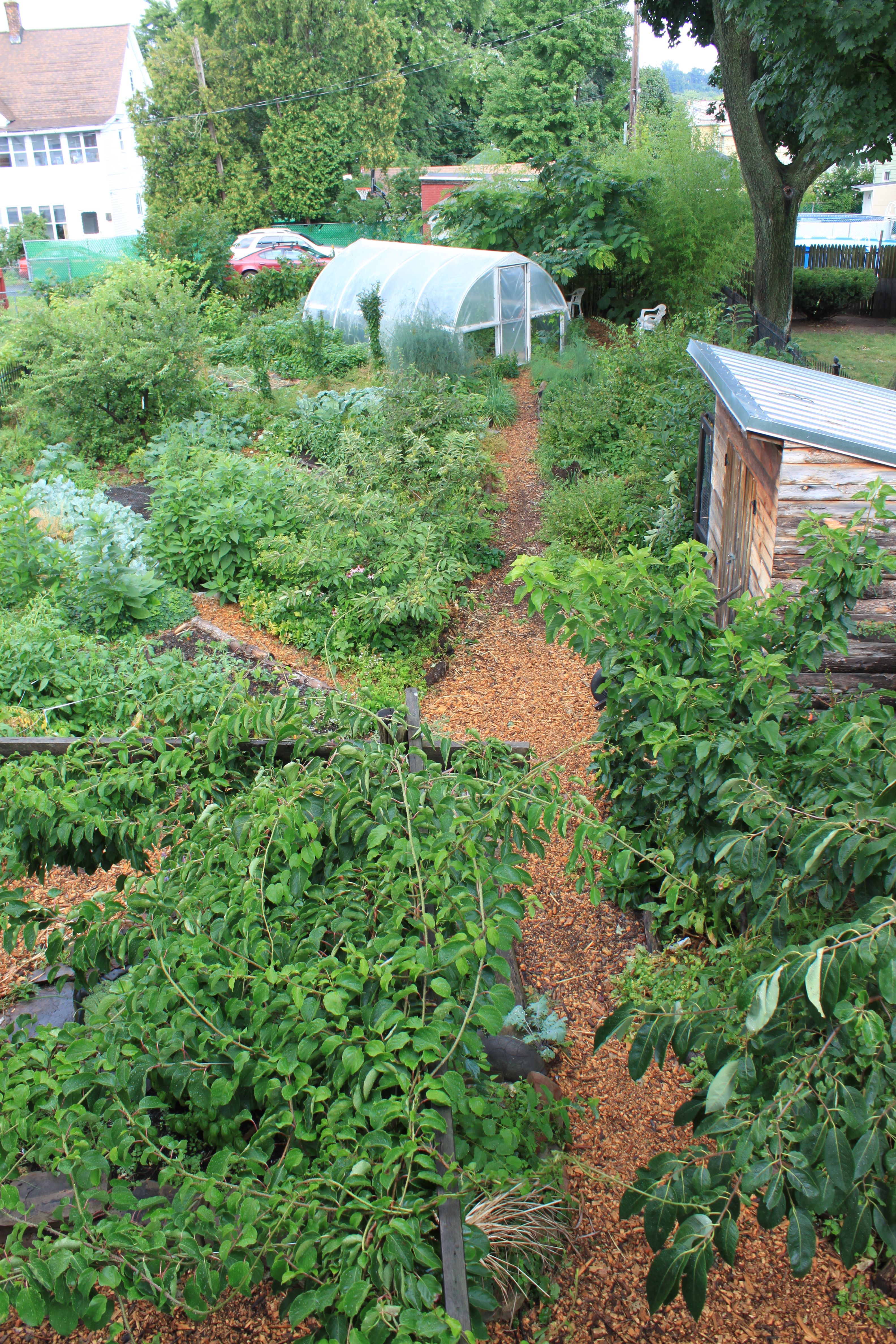
My project took place in Portland OR, his on the other side of the continent in Holyoke MA. My lot was two tenths of an acre, his lot half that. But besides differences in space for trees, and somewhat different plant palettes, Eric Toensmeir's account in Paradise Lot of applied permaculture reads like a parallel universe of my own experimentations with urban lot rehabilitation and perennial polycultures. We each started with infertile and unpromising soil, but guided by permaculture literature from other regions and with the help of gardening partners (romantic in my case; friend Jonathan Bates in his), we embarked on labors of faith towards similar goals of abundant food production and restored habitat health.

And we both succeeded. I've documented most of my experiments, successes, and failures on this blog. Toensmeier has shared much of his plant knowledge, from which I've drawn heavily, in the appendices of Edible Forest Gardens: Volume Two (coauthored with Dave Jacke), his book Perennial Vegetables, and his DVD Perennial Vegetable Gardening. But besides early site analysis in Edible Forest Gardens, a few video clips from garden tours, and the Apios Institute wiki behind a paywall, we haven't gotten many details on the overall transformation of his lot or on his polyculture explorations. Paradise Lot provides a fairly thorough account of how Toensmeir and Bates selected, analyzed, amended, sheet-mulched, planted, and enlivened their site. Though the theoretical process is well described in various forest gardening books, it doesn't hurt to have another case study providing specific details of how a site plan can evolve over the years.

Many individual species are briefly described, without many surprises for those who have already devoured references like Perennial Vegetables and Martin Crawford's Creating a Forest Garden. Most exciting for me is Toensmeier and Bates covering new ground with perennial polycultures (literally). It seems they encountered many of the same challenges I had with perennial polyculture design, especially from lack of hands-on experience growing and using individual species. It's difficult to assemble successful mixes without intimately understanding the life cycle, growth habits, and harvest season of each component. Amusingly, they created a hog-peanut/gooseberry mess similar to, though not as bad as, my infamous gooseberry/stinging nettle polyculture. A great example of why we need to share information about what works and what doesn't, to reduce effort wasted on demonstrably bad combinations!

Disappointingly, the book ends before Toensmeier has had a chance to develop many successful polycultures, similar to my timing of moving before getting to implement my own new perennial polyculture designs. Even so, there are some succesful polycultures and further hints and lessons in the book. Notably, he arrived at the same conclusion I did: low, spreading groundcovers are critical components. He describes success with some strawberry species, a violet, and some native plants, but without many details beyond that of what specific crops to fit together.

I find it very promising that we achieved similar positive results in fairly different climates. We both successfully rehabilitated trashed urban lots into land that could support both humans and non-humans. We both, through the simple techniques of heavy mulching to build soil and planting a wide variety of perennials, created habitat for greater numbers and species diversity of insects, birds, and other life. By selecting mostly edibles for our plantings, we both wound up with abundant harvests of low-maintenance perennial vegetables. (And we both had a shortage of perennial greens in the summer; apparently this has more to do with the life cycles of perennials than with the summer drought of the Pacific Northwest.) We both had similar success allowing natural predators to handle pest outbreaks. We both put a lot of time up-front into planning and design, but both made lots of mistakes easily avoidable by others learning from our examples, so I feel pretty confident that our achievements are replicable by anyone who takes this approach with even a minimum of planning and research.

I felt surprised by how much focus Toensmeir put on nitrogen-fixers, as I realized a couple years into our endeavour that one person's urine fertilizes 4000-5000sf of forest garden, the size of their entire lot. Despite cycling the urine from four adults into the yard, Toensmeier is still carefully planning N-fixing plants at the end of the book. Perhaps they all spend so much time off-site that they can't capture enough urine, or perhaps Toensmeir never thought to calculate this?

The book also features a strong subplot of the two bachelors hoping to attract mates, with as much success as in their gardening! Personally, I was much more interested in the plant-geek narrative, but I'm sure many readers will appreciate the human interest story balancing out the site analysis and gardening.

Toensmeir explores some of the dynamics of the neighborhood, the town of Holyoke, and the even broader community. I found his vague hope of inspiring change through personal example to be unconvincing. I'm fairly jaded by my own experience in Portland attempting to model something approximating urban self-sufficiency and sustainability: not only were our inputs of free wood chips and dumpstered waste streams unscaleable to more than a small fraction of the entire city, and not only did I conclude that Portland would have to kick out half the population even in a wildly optimistic scenario of everyone doing a better job than we'd managed, but only a handful of the people who toured our yard actually adopted perennials to any great extent. So I'm pessimistic (or realistic) about the inability of cities to ever support their populations in any sustainable manner.

But that's fairly tangential to the main focus of the book, and certainly anyone interested in urban, suburban, or rural zone 1 and 2 gardening can and should learn from this case study. It's a quick, fun, and relatively light read. Enjoy!

Tuesday, December 09, 2014

Shading paths in Hawai'i

This post follows up on the concepts of my post Sun and Shade, Temperate vs Tropical, with some quick thoughts on paths. Ideally, Hawaiian paths would be shaded in the summer for protection of humans from the sun and maximum photosynthesis, but more open in the wet winters to prevent too much mud and muckiness.

Paths running east-west could have large trees planted on the north side to overhang the path enough to provide shade from the spring to fall equinox, while allowing winter sun to enter from the south.

Paths running north-south could be treated in one of a few ways:

  • Compromise plantings of hedges or trees at wide enough spacings or with relatively sparse canopies to provide incomplete summer shade and incomplete winter sun.
  • Coppiceable plantings of quick-growing trees or tall hedges, cut in the winter and allowed to grow through the summer. This would work well with N-fixers to provide mulch easily transported along the paths to desired destinations.
  • Deciduous plantings (such as kapok) providing the standard summer shade/winter sun service.