Showing posts with label ground cover. Show all posts

Monday, January 12, 2015

Book review: Eric Toensmeir's Paradise Lot - parallel universe?

My yard Toensmeier's yard

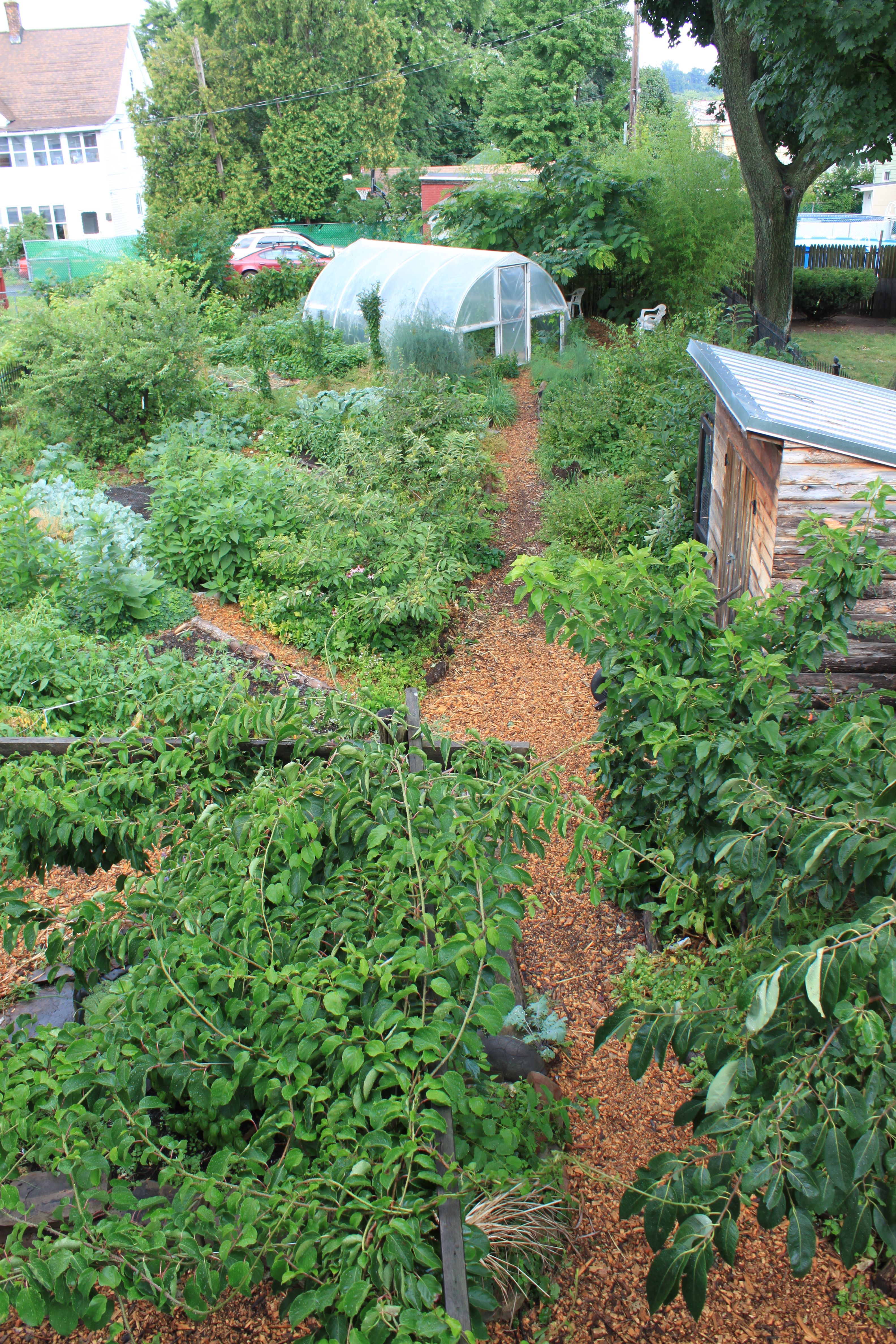
My project took place in Portland OR, his on the other side of the continent in Holyoke MA. My lot was two tenths of an acre, his lot half that. But besides differences in space for trees, and somewhat different plant palettes, Eric Toensmeir's account in Paradise Lot of applied permaculture reads like a parallel universe of my own experimentations with urban lot rehabilitation and perennial polycultures. We each started with infertile and unpromising soil, but guided by permaculture literature from other regions and with the help of gardening partners (romantic in my case; friend Jonathan Bates in his), we embarked on labors of faith towards similar goals of abundant food production and restored habitat health.

And we both succeeded. I've documented most of my experiments, successes, and failures on this blog. Toensmeier has shared much of his plant knowledge, from which I've drawn heavily, in the appendices of Edible Forest Gardens: Volume Two (coauthored with Dave Jacke), his book Perennial Vegetables, and his DVD Perennial Vegetable Gardening. But besides early site analysis in Edible Forest Gardens, a few video clips from garden tours, and the Apios Institute wiki behind a paywall, we haven't gotten many details on the overall transformation of his lot or on his polyculture explorations. Paradise Lot provides a fairly thorough account of how Toensmeir and Bates selected, analyzed, amended, sheet-mulched, planted, and enlivened their site. Though the theoretical process is well described in various forest gardening books, it doesn't hurt to have another case study providing specific details of how a site plan can evolve over the years.

Many individual species are briefly described, without many surprises for those who have already devoured references like Perennial Vegetables and Martin Crawford's Creating a Forest Garden. Most exciting for me is Toensmeier and Bates covering new ground with perennial polycultures (literally). It seems they encountered many of the same challenges I had with perennial polyculture design, especially from lack of hands-on experience growing and using individual species. It's difficult to assemble successful mixes without intimately understanding the life cycle, growth habits, and harvest season of each component. Amusingly, they created a hog-peanut/gooseberry mess similar to, though not as bad as, my infamous gooseberry/stinging nettle polyculture. A great example of why we need to share information about what works and what doesn't, to reduce effort wasted on demonstrably bad combinations!

Disappointingly, the book ends before Toensmeier has had a chance to develop many successful polycultures, similar to my timing of moving before getting to implement my own new perennial polyculture designs. Even so, there are some succesful polycultures and further hints and lessons in the book. Notably, he arrived at the same conclusion I did: low, spreading groundcovers are critical components. He describes success with some strawberry species, a violet, and some native plants, but without many details beyond that of what specific crops to fit together.

I find it very promising that we achieved similar positive results in fairly different climates. We both successfully rehabilitated trashed urban lots into land that could support both humans and non-humans. We both, through the simple techniques of heavy mulching to build soil and planting a wide variety of perennials, created habitat for greater numbers and species diversity of insects, birds, and other life. By selecting mostly edibles for our plantings, we both wound up with abundant harvests of low-maintenance perennial vegetables. (And we both had a shortage of perennial greens in the summer; apparently this has more to do with the life cycles of perennials than with the summer drought of the Pacific Northwest.) We both had similar success allowing natural predators to handle pest outbreaks. We both put a lot of time up-front into planning and design, but both made lots of mistakes easily avoidable by others learning from our examples, so I feel pretty confident that our achievements are replicable by anyone who takes this approach with even a minimum of planning and research.

I felt surprised by how much focus Toensmeir put on nitrogen-fixers, as I realized a couple years into our endeavour that one person's urine fertilizes 4000-5000sf of forest garden, the size of their entire lot. Despite cycling the urine from four adults into the yard, Toensmeier is still carefully planning N-fixing plants at the end of the book. Perhaps they all spend so much time off-site that they can't capture enough urine, or perhaps Toensmeir never thought to calculate this?

The book also features a strong subplot of the two bachelors hoping to attract mates, with as much success as in their gardening! Personally, I was much more interested in the plant-geek narrative, but I'm sure many readers will appreciate the human interest story balancing out the site analysis and gardening.

Toensmeir explores some of the dynamics of the neighborhood, the town of Holyoke, and the even broader community. I found his vague hope of inspiring change through personal example to be unconvincing. I'm fairly jaded by my own experience in Portland attempting to model something approximating urban self-sufficiency and sustainability: not only were our inputs of free wood chips and dumpstered waste streams unscaleable to more than a small fraction of the entire city, and not only did I conclude that Portland would have to kick out half the population even in a wildly optimistic scenario of everyone doing a better job than we'd managed, but only a handful of the people who toured our yard actually adopted perennials to any great extent. So I'm pessimistic (or realistic) about the inability of cities to ever support their populations in any sustainable manner.

But that's fairly tangential to the main focus of the book, and certainly anyone interested in urban, suburban, or rural zone 1 and 2 gardening can and should learn from this case study. It's a quick, fun, and relatively light read. Enjoy!

Saturday, July 12, 2014

Perennial Greens Planting Plan

Zone 1, extending into zone 2. From bottom center, working counter-clockwise:
Giant sea kale, sweet cicely in seed, turkish rocket, zebra mallow in flower, perennial kale in seed, lemon balm, french sorrel in seed, borage in flower, elephant garlic in flower, sylvetta arugula in flower, and nipplewort.
Also skirret & chinese dogwood in background, with crocosmia in foreground.

Two mistakes I made in my perennial vegetable experimentations in Portland:

  1. I overplanted perennial greens, more than we could possibly eat.
  2. I planted the greens over a large area, forcing more traversal of the yard than necessary. Though walking the yard to pick greens helps keep an eye on everything, it's inefficient to go further than necessary on a nearly daily basis.

Before we sold the house, I was consolidating a core set of perennial greens into approximately 100 square feet of beds closest to the house. This brought the front yard garden into better alignment with design by zones, with a tight zone 1 producing the majority of the daily pickings for two adults (leaves & flowers, salads & cooked), and freeing up zone 2 for root crops and less frequently harvested vegetables. I still envisioned picking from zone 2, from deliberate plantings and from edible weeds, a few times a week for variety and to augment zone 1 production.

This design took advantage of the fact that, for much of the year, the house shades most of the front yard area closest to it (especially after we raised the house 3'.) Most of the perennial greens should do well in partial to full shade, whereas the root crops and annuals generally need more sun. Most herbs also want full sun, and we found we didn't need to pick them with each batch of greens, so the larger ones made more sense for us in zone 2.

Writing this up two years later, I don't remember the exact number of which plants I moved into zone 1, but I believe I've come close below. It's a good starting point; you'll need to experiment anyway with what works well in your site and what you like to eat. Regardless of the exact species composition, the end result of densely planted perennials should be a yield of greens requiring little to no work besides harvest - more or less no need to dig soil, replant, or weed. (And year-round, at least in Portland and similarly mild winter climates.)

Large Plants

Usually planted 2-3' apart. You can perhaps get away with closer spacing in a heavily harvested zone 1, but I'd be inclined to still give them full spacing.

QtyLatin nameCommon name
1Agastache foeniculumAnise hyssop
1Brassica oleracea acephalaTree collards
3Brassica oleracea acephala'Western Front' perennial kale
1Crambe cordifoliaGiant sea kale
2Crambe maritimaSea kale
1Foeniculum vulgareFennel
2Malva sylvestris mauritianaZebra mallow
1Malva moschataMusk mallow
2Melissa officinalisLemon balm
1Myrrhis odorataSweet cicely
2Rumex scutatus or R. acetosaFrench Sorrel
6 sfScorzonera hispanicaScorzonera

Groundcovers

These can be planted under and around the large plants, to exclude weeds and provide bonus greens & flowers.

Latin nameCommon name
Barbarea vernaWintercress
Campanula portenschlagianaBellflower
Campanula poscharskyanaTrailing bellflower
Claytonia montiaMiner's lettuce
Claytonia sibericaSiberian miner's lettuce
Diplotaxis tenuifoliaSylvetta arugala
Origanum sppOregano species
Oxalis oregonaRedwood sorrel
Rumex acetosellaSheeps sorrel
Sanguisorba minorSalad burnet
Stellaria mediaChickweed
Taraxacum officianaleDandelion
Thymus sppThyme species
Viola sppViolets

Bed Edges

We used a lot of Allium greens, finding them much easier to grow than bulbing onions. These work well along the edges of beds, helping delineate the pathways.

Latin nameCommon name
Allium ampeloprasumElephant garlic / Leek
A. cepa 'proliferum'Egyptian walking onion
Allium cernuumNodding onion
Allium fistulosumBunching onion
Allium sativumGarlic
Allium schoenoprasumChives
Allium tuberosumGarlic chives

Zone 2 Greens

If you have more room available, I would experiment with these. For species already listed above, numbers given are in addition to the quantity in zone 1. These are just for greens and flowers; not considering root and seed harvests of things like yellow asphodel and good king henry.

QtyLatin nameCommon name
1Agastache foeniculumAnise hyssop
5Anthriscus sylvestrisWoodland chervile
2Aquilegia vulgarisColumbine
4Asphodeline luteaYellow asphodel
2-3Bunias orientalisTurkish rocket
4Campanula rapunculoides, C. persicifolia, and other tall speciesBellflowers
10Chenopodium bonus-henricusGood King Henry
2Crambe maritimaSea kale
1-2Foeniculum vulgareFennel
1Levisticum officinaleLovage
1Lycium barbarumWolfberry
6sfMentha spicataSpearmint
1-2Myrrhis odorataSweet cicely
3-4Oenothera biennisEvening primrose
3Rumex scutatus or R. acetosiaFrench sorrel
2Smyrnium olusatrumAlexanders
1Symphytum officinalisComfrey
10sfUrtica dioicaStinging nettles

Zone 2 Stems & Shoots

Other vegetables nice to grow for something other than greens and flowers.

Latin nameCommon name
Arctium lappa or A. minorBurdock
Asparagus officinalisAsparagus
Maianthemum racemosumFalse solomon's seal
Petasites frigidusSweet Coltsfoot
Petasites japonicusFuki
Polygonatum biflorum and P. commutatumSolomon's seal
Rheum x cultorumRhubarb

Zone 2 Weeds

Volunteers that often need to be kept in check. We generally ate these rather than weeding per se.

Latin nameCommon name
Borago officinalisBorage
Calendula officinalisCalendula
Cardamine unknownPopweed
Geum urbanumClove root
Lamium purpuruemPurple dead nettle
Lapsana communisNipplewort
Phytolacca americanaPokeweed
Solanum nigrumBlack nightshade
Taraxacum officinaleDandelion

Monday, November 11, 2013

Lost in the Food Forest: rampant growth in Portland

I sent this email years ago to the Portland Permaculture Guild, offering some tips and discoveries from our experiments with dense interplantings in zones 1 and 2:

In zone 1 we have a pretty easy time keeping growth balanced as part of the once or twice daily gathering of greens for salad and omelets, plus occasional dedicated large-scale whack-backs.

Prune/whack ruthlessly where needed. Leave in place as mulch wherever you can.

Designate your paths, at least 2' for main access routes, at least 1.5' for keyhole paths. The plants will invade the paths no matter what, so don't be afraid to make the paths "too big"; you can decrease the frequency and/or severity of your whack-backs if you find you don't mind the plants taking up some of the path. If you make the paths too small you'll guarantee an unpleasant walk through the garden and/or increased maintenance.

Place plants far enough from the paths that they don't interfere.  It can be difficult to determine spacing for perennial veggies based on book data alone; we find that tall plants may fall over into the path after summer rains since they haven't grown up accustomed to the weight of water. I used to want to plant a 3' wide plant (based on book data) exactly 1.5' back from the path to maximize the plant packing. But I now think you need to give a large buffer - maybe 2.5' from the path, and fill in the gap between the large plant and the path with a low-growing plant. You can easily trample the low-grower if it exceeds its allotted space. This makes for easier harvesting anyway--you can reach the large plant in the middle of the bed, and the small plant(s) at the edges.

It's OK to plant the plants more closely together inside the bed--they'll work things out if they crowd or fall onto each other. So I would place two plants with expected 3' maximum width 3' apart from each other. Dedicated trample-tolerant very low-growing ground covers help delineate the path, keep bed plants from spreading into the path, and can fix nitrogen, accumulate nutrients, etc. We're having good success with:
  • prostrate bird's food trefoil (Lotus corniculatus plena)
  • "Treneague" variety chamomile (Chamaemelum nobile)
  • what I think is dutch white clover (Trifolium repens)
  • Pacific silverweed (Potentilla anserina)
Those cute little squash volunteers that look so harmless in late spring will take over 6' or more in every direction if you let them grow. Don't, unless you're really OK with it. Similarly, be realistic that squashes you deliberately plant will want lots of space.

Give climbing plants something to climb, or be aware that they will sprawl across the ground. Tomatoes, squashes, beans/peas/groundnuts/hog peanuts, and mashua will all sprawl if they don't find vertical supports. Some of them will sprawl anyway, and require deliberate guidance to minimize horizontal spread.