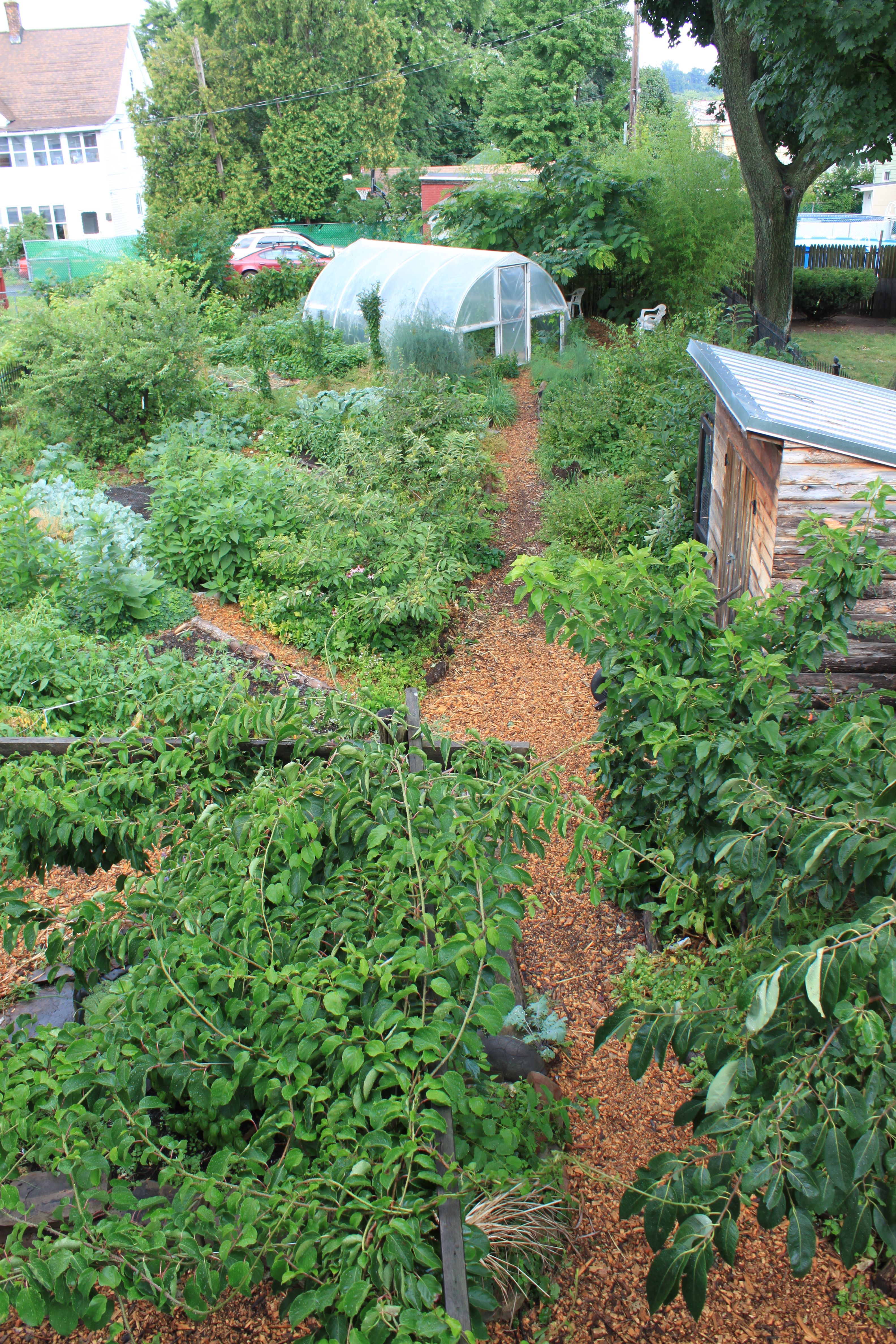
Showing posts with label Perennial veggies. Show all posts

Monday, May 07, 2018

Blog to know: Tropical Self Sufficiency

A Puna, Hawai'i resident named Spencer has been experimenting for a couple of years with perennials in the tropics, and he's written up some excellent experience based species profiles. You'll find many of the species explored by Toensmeier's Perennial Vegetables, one of Spencer's inspirations. Some species are purely tropical, but many are familiar friends (or could become such!) of temperate permaculturists as well.

The site is loaded with information on propagation, growth, harvest, and use of perennials, in a combination of collated research and original discoveries. Multiple photos accompany each entry, usually including shots of the plants living in polycultures, with the surrounding species conveniently named as well. As the site title indicates, there's an emphasis on staple crops.

All in all, my kind of info-dense resource! Check out Spencer's site at Tropical Self Sufficiency.

Saturday, February 06, 2016

(Relatively) quick-yielding perennials

As the new growing season approaches, you may want to plan for some low-maintenance, habitat-building perennial plants to supplement or replace some of your annuals. A friend just asked me, "Do you have any garden plant recommendations for us here in Eugene? We're interested in perennials that establish relatively quickly and provide a good crop in the first year or two." I replied with the following:

Very few perennials will yield much, if at all, in the first year, especially if you're trying to let them establish for a strong future. Some will yield decently in the 2nd year, but for most you'll have to wait til the 3rd year or later. (Assuming from seed - starting with transplants or tubers will speed it up.) That said, I'll include everything below which gives some harvest in the specified time frames, but don't expect huge returns.

First year

  • French sorrel
  • Mallows (Malva sp.)
  • Anise hyssop, lemon balm, peppermint, other mints
  • Fennel
  • Andean tubers (mashua, oca, yacon)
  • Jerusalem artichoke
  • Wapato
  • Salad burnet
  • Alliums
  • Columbine
  • Malabar spinach
  • Comfrey
  • Perennial kale
  • Chicory
  • Perennial arugula (Diplotaxis sp)
  • Sweet potato for greens?
  • Scarlet runner beans
  • Lactuca perennis

Second year

  • Scorzonera leaves & flowers, and maybe roots
  • Fuki
  • Bellflowers (Campanula sp)
  • Strawberries
  • Lovage
  • Dandelion
  • Miner's lettuce
  • Daylily from divisions
  • Sedums
  • Good King Henry
  • Cow parsley
  • Tree collard
  • Turkish rocket
  • Sea kale & giant sea kale
  • Mitsuba
  • Hot tuna
  • Sweet cicely
  • Sorrels (Oxalis sp)
  • Pokeweed
  • Rhubarb & Asparagus (a little bit)
  • New Zealand spinach? (not successful for us)
  • Violets

Self-seeding annuals (such as Amaranthus sp, Chenopodium sp, Calendula, Land cress, and Borage) and biennials (such as Angelica, Burdock, Evening primrose, and Alexanders) are intermediate in investment and return, yielding in the first year yet often persisting in the garden. It's also well worth identifying and researching all your "weeds", since many of them are probably edible and provide an immediate easy yield.

Monday, January 12, 2015

Book review: Eric Toensmeir's Paradise Lot - parallel universe?

My yard Toensmeier's yard

My project took place in Portland OR, his on the other side of the continent in Holyoke MA. My lot was two tenths of an acre, his lot half that. But besides differences in space for trees, and somewhat different plant palettes, Eric Toensmeir's account in Paradise Lot of applied permaculture reads like a parallel universe of my own experimentations with urban lot rehabilitation and perennial polycultures. We each started with infertile and unpromising soil, but guided by permaculture literature from other regions and with the help of gardening partners (romantic in my case; friend Jonathan Bates in his), we embarked on labors of faith towards similar goals of abundant food production and restored habitat health.

And we both succeeded. I've documented most of my experiments, successes, and failures on this blog. Toensmeier has shared much of his plant knowledge, from which I've drawn heavily, in the appendices of Edible Forest Gardens: Volume Two (coauthored with Dave Jacke), his book Perennial Vegetables, and his DVD Perennial Vegetable Gardening. But besides early site analysis in Edible Forest Gardens, a few video clips from garden tours, and the Apios Institute wiki behind a paywall, we haven't gotten many details on the overall transformation of his lot or on his polyculture explorations. Paradise Lot provides a fairly thorough account of how Toensmeir and Bates selected, analyzed, amended, sheet-mulched, planted, and enlivened their site. Though the theoretical process is well described in various forest gardening books, it doesn't hurt to have another case study providing specific details of how a site plan can evolve over the years.

Many individual species are briefly described, without many surprises for those who have already devoured references like Perennial Vegetables and Martin Crawford's Creating a Forest Garden. Most exciting for me is Toensmeier and Bates covering new ground with perennial polycultures (literally). It seems they encountered many of the same challenges I had with perennial polyculture design, especially from lack of hands-on experience growing and using individual species. It's difficult to assemble successful mixes without intimately understanding the life cycle, growth habits, and harvest season of each component. Amusingly, they created a hog-peanut/gooseberry mess similar to, though not as bad as, my infamous gooseberry/stinging nettle polyculture. A great example of why we need to share information about what works and what doesn't, to reduce effort wasted on demonstrably bad combinations!

Disappointingly, the book ends before Toensmeier has had a chance to develop many successful polycultures, similar to my timing of moving before getting to implement my own new perennial polyculture designs. Even so, there are some succesful polycultures and further hints and lessons in the book. Notably, he arrived at the same conclusion I did: low, spreading groundcovers are critical components. He describes success with some strawberry species, a violet, and some native plants, but without many details beyond that of what specific crops to fit together.

I find it very promising that we achieved similar positive results in fairly different climates. We both successfully rehabilitated trashed urban lots into land that could support both humans and non-humans. We both, through the simple techniques of heavy mulching to build soil and planting a wide variety of perennials, created habitat for greater numbers and species diversity of insects, birds, and other life. By selecting mostly edibles for our plantings, we both wound up with abundant harvests of low-maintenance perennial vegetables. (And we both had a shortage of perennial greens in the summer; apparently this has more to do with the life cycles of perennials than with the summer drought of the Pacific Northwest.) We both had similar success allowing natural predators to handle pest outbreaks. We both put a lot of time up-front into planning and design, but both made lots of mistakes easily avoidable by others learning from our examples, so I feel pretty confident that our achievements are replicable by anyone who takes this approach with even a minimum of planning and research.

I felt surprised by how much focus Toensmeir put on nitrogen-fixers, as I realized a couple years into our endeavour that one person's urine fertilizes 4000-5000sf of forest garden, the size of their entire lot. Despite cycling the urine from four adults into the yard, Toensmeier is still carefully planning N-fixing plants at the end of the book. Perhaps they all spend so much time off-site that they can't capture enough urine, or perhaps Toensmeir never thought to calculate this?

The book also features a strong subplot of the two bachelors hoping to attract mates, with as much success as in their gardening! Personally, I was much more interested in the plant-geek narrative, but I'm sure many readers will appreciate the human interest story balancing out the site analysis and gardening.

Toensmeir explores some of the dynamics of the neighborhood, the town of Holyoke, and the even broader community. I found his vague hope of inspiring change through personal example to be unconvincing. I'm fairly jaded by my own experience in Portland attempting to model something approximating urban self-sufficiency and sustainability: not only were our inputs of free wood chips and dumpstered waste streams unscaleable to more than a small fraction of the entire city, and not only did I conclude that Portland would have to kick out half the population even in a wildly optimistic scenario of everyone doing a better job than we'd managed, but only a handful of the people who toured our yard actually adopted perennials to any great extent. So I'm pessimistic (or realistic) about the inability of cities to ever support their populations in any sustainable manner.

But that's fairly tangential to the main focus of the book, and certainly anyone interested in urban, suburban, or rural zone 1 and 2 gardening can and should learn from this case study. It's a quick, fun, and relatively light read. Enjoy!

Saturday, July 12, 2014

Perennial Greens Planting Plan

Zone 1, extending into zone 2. From bottom center, working counter-clockwise:
Giant sea kale, sweet cicely in seed, turkish rocket, zebra mallow in flower, perennial kale in seed, lemon balm, french sorrel in seed, borage in flower, elephant garlic in flower, sylvetta arugula in flower, and nipplewort.
Also skirret & chinese dogwood in background, with crocosmia in foreground.

Two mistakes I made in my perennial vegetable experimentations in Portland:

  1. I overplanted perennial greens, more than we could possibly eat.
  2. I planted the greens over a large area, forcing more traversal of the yard than necessary. Though walking the yard to pick greens helps keep an eye on everything, it's inefficient to go further than necessary on a nearly daily basis.

Before we sold the house, I was consolidating a core set of perennial greens into approximately 100 square feet of beds closest to the house. This brought the front yard garden into better alignment with design by zones, with a tight zone 1 producing the majority of the daily pickings for two adults (leaves & flowers, salads & cooked), and freeing up zone 2 for root crops and less frequently harvested vegetables. I still envisioned picking from zone 2, from deliberate plantings and from edible weeds, a few times a week for variety and to augment zone 1 production.

This design took advantage of the fact that, for much of the year, the house shades most of the front yard area closest to it (especially after we raised the house 3'.) Most of the perennial greens should do well in partial to full shade, whereas the root crops and annuals generally need more sun. Most herbs also want full sun, and we found we didn't need to pick them with each batch of greens, so the larger ones made more sense for us in zone 2.

Writing this up two years later, I don't remember the exact number of which plants I moved into zone 1, but I believe I've come close below. It's a good starting point; you'll need to experiment anyway with what works well in your site and what you like to eat. Regardless of the exact species composition, the end result of densely planted perennials should be a yield of greens requiring little to no work besides harvest - more or less no need to dig soil, replant, or weed. (And year-round, at least in Portland and similarly mild winter climates.)

Large Plants

Usually planted 2-3' apart. You can perhaps get away with closer spacing in a heavily harvested zone 1, but I'd be inclined to still give them full spacing.

QtyLatin nameCommon name
1Agastache foeniculumAnise hyssop
1Brassica oleracea acephalaTree collards
3Brassica oleracea acephala'Western Front' perennial kale
1Crambe cordifoliaGiant sea kale
2Crambe maritimaSea kale
1Foeniculum vulgareFennel
2Malva sylvestris mauritianaZebra mallow
1Malva moschataMusk mallow
2Melissa officinalisLemon balm
1Myrrhis odorataSweet cicely
2Rumex scutatus or R. acetosaFrench Sorrel
6 sfScorzonera hispanicaScorzonera

Groundcovers

These can be planted under and around the large plants, to exclude weeds and provide bonus greens & flowers.

Latin nameCommon name
Barbarea vernaWintercress
Campanula portenschlagianaBellflower
Campanula poscharskyanaTrailing bellflower
Claytonia montiaMiner's lettuce
Claytonia sibericaSiberian miner's lettuce
Diplotaxis tenuifoliaSylvetta arugala
Origanum sppOregano species
Oxalis oregonaRedwood sorrel
Rumex acetosellaSheeps sorrel
Sanguisorba minorSalad burnet
Stellaria mediaChickweed
Taraxacum officianaleDandelion
Thymus sppThyme species
Viola sppViolets

Bed Edges

We used a lot of Allium greens, finding them much easier to grow than bulbing onions. These work well along the edges of beds, helping delineate the pathways.

Latin nameCommon name
Allium ampeloprasumElephant garlic / Leek
A. cepa 'proliferum'Egyptian walking onion
Allium cernuumNodding onion
Allium fistulosumBunching onion
Allium sativumGarlic
Allium schoenoprasumChives
Allium tuberosumGarlic chives

Zone 2 Greens

If you have more room available, I would experiment with these. For species already listed above, numbers given are in addition to the quantity in zone 1. These are just for greens and flowers; not considering root and seed harvests of things like yellow asphodel and good king henry.

QtyLatin nameCommon name
1Agastache foeniculumAnise hyssop
5Anthriscus sylvestrisWoodland chervile
2Aquilegia vulgarisColumbine
4Asphodeline luteaYellow asphodel
2-3Bunias orientalisTurkish rocket
4Campanula rapunculoides, C. persicifolia, and other tall speciesBellflowers
10Chenopodium bonus-henricusGood King Henry
2Crambe maritimaSea kale
1-2Foeniculum vulgareFennel
1Levisticum officinaleLovage
1Lycium barbarumWolfberry
6sfMentha spicataSpearmint
1-2Myrrhis odorataSweet cicely
3-4Oenothera biennisEvening primrose
3Rumex scutatus or R. acetosiaFrench sorrel
2Smyrnium olusatrumAlexanders
1Symphytum officinalisComfrey
10sfUrtica dioicaStinging nettles

Zone 2 Stems & Shoots

Other vegetables nice to grow for something other than greens and flowers.

Latin nameCommon name
Arctium lappa or A. minorBurdock
Asparagus officinalisAsparagus
Maianthemum racemosumFalse solomon's seal
Petasites frigidusSweet Coltsfoot
Petasites japonicusFuki
Polygonatum biflorum and P. commutatumSolomon's seal
Rheum x cultorumRhubarb

Zone 2 Weeds

Volunteers that often need to be kept in check. We generally ate these rather than weeding per se.

Latin nameCommon name
Borago officinalisBorage
Calendula officinalisCalendula
Cardamine unknownPopweed
Geum urbanumClove root
Lamium purpuruemPurple dead nettle
Lapsana communisNipplewort
Phytolacca americanaPokeweed
Solanum nigrumBlack nightshade
Taraxacum officinaleDandelion

Sunday, April 13, 2014

Self Sufficiency, Five Years In - audio slideshow

In spring 2011, I gave a presentation three times on the progress, successes, failures, and lessons from five years of working towards self sufficiency with my ex-partner at our house in Portland. I advertised the event with this blurb:

In March of 2006, Tulsi and Norris purchased a small house on a .2 acre lot, and used permaculture principles to design their food forest, sun garden, and house renovation. They aimed to create a low-maintenance, truly sustainable habitat for 2-4 people plus wildlife, providing from the property all necessary food, heating & cooking fuel, water, and waste treatment. Join us for a reality check on what's worked and what hasn't, what seems theoretically possible for the future, and what all this means to the oxymoronic goal of a sustainable city.

I've finally synced up an audio recording I made of my presentation with the slide images, to make a sort-of movie. You can view the Self Sufficiency, Five Years In slideshow online (may require reasonably fast internet connection) or download a 36MB zip file for offline viewing. (Extract to anywhere on your hard drive, then open the included index.html file in your web browser.)

I've also created a video, which requires more bandwidth: Self Sufficiency, Five Years In on YouTube. (You can download the 166MB WMV movie file or watch it below)

Or you can download a 6 MB PDF of the slideshow without audio.

Sunday, December 15, 2013

Photo album: Going Garden, June 2013

I created an album of photos taken by Jasmine van den Heuvel in June 2013, of my old forest garden in Portland. The new owners have changed a few things around in their first year and a quarter:
  • Replaced half to two-thirds of the zone 1 perennial beds with annual beds
  • Removed the double row of failing raspberries near the house and mostly left it open (at least for now?) as a big path
  • Ironically, after we removed the herb spiral which didn't work very well and dug a catchment pond, the new owners filled in the pond and made a little herb spiral in its place
  • Replaced the dead olive in zone 2 and its perennial understory with annuals
  • Replaced a large swath of the former driveway, including a sickly or dead pawpaw circle, with a strawberry mound
  • Planted some new trees: figs on west side of house, pawpaw in back yard
  • Removed the backyard chicken paddock fences
  • Replaced the wood shed in the backyard with a second chicken coop (or run?) next to our original coop


View the album

Friday, August 24, 2012

Crop summary: Darmera peltata - Umbrella Plant or Indian Rhubarb


Years ago, on the Klamath River of northern California, I came across and later identified Darmera peltata, known as Umbrella Plant or Indian Rhubarb. The plant grows on rocks along rivers and in other wet places, putting out long stalks terminating in the center of large roundish leaves.
I felt excited when I learned that you can eat the leaf stalks, but I didn't have a chance to actually try them out until this summer. Plants for a Future says to peel the stalks and eat them raw or cooked. After a little trial and error, I determined that the basal portion of the stem has a lot of fiber, but still a soft, juicy core with a mild flavor and a lot of water. I pulled off the outer full-on fibrous layer, chewed on the inner parts, and wound up with fiber wads which I spat out or swallowed. Towards the top of each stalk, the outer fiber layer hadn't developed yet and I could eat the entire stalk without peeling, a very nice nibble. The very top inch or so of stalk has the same pliability, but tastes fairly bitter. Perhaps cooking would mitigate the bitterness; I didn't try cooking any of the stalks so can't say how that affects the flavor or tenderness.

I wouldn't grow Umbrella Plant in an urban setting with limited clean-water aquatic space; I would instead plant some aquatic or wetland root crops. But I would definitely consider Umbrella Plant for graywater areas where you wouldn't want to eat plant parts in contact with the soil anyway. And if I had a stretch of natural creek or river on larger acreage, I would experiment with it as a water edge plant in rocky areas.

Saturday, June 23, 2012

Crop summary: Saltbush, Atriplex canescens & A. halimus

We tried growing two species of saltbush - Atriplex canescens and A. halimus.  I think I received both from the National Germplasm Repository - definitely A. canescens (PI 508551), but I can't find my records on the A. halimus.  In June of 2009 I wrote a short report-back on the performance of the A. canescens:

Planted out two plants which seemed to establish well in 2008. Tasted the leaves last summer, and a friend and I both found them disgusting, contrary to highly positive reports from permaculture literature. Over the winter, both plants died to the ground, which surprised me. One plant re-sprouted this year and looks healthy, while the other plant never re-sprouted. I expected them to be hardier in our climate. On a positive note, the plant which re-sprouted now makes leaves which taste very good, with the salt-flavor-burst and a pleasant aftertaste.

And an update written from memory June 2012: later in the season the leaves started tasting disgusting again. The following winter killed the remaining plant off for good.

I remember very little about the A. halimus, except that it suffered from the same die-back or die-off problems over the winter(s). If I ever tasted it, it didn't taste good enough for me to have marked it in my memory as worth eating.

Both species should easily handle the coldness of our winters (with A. halimus approaching marginal hardiness at about 10F, but still below our usual coldest temps). However, the Plants for a Future database reports that both plants "are apt to succumb to winter wet when grown on heavy or rich soil" which probably explains our winter failures.

I see a lot of potential for these species, but we would need to figure out how to give them good drainage over the winter, and experiment more to have consistently good tasting leaves. Were I to try them again, I would experiment with soil conditions (try some poor soil instead of just rich garden soil), obtain seeds or preferably cuttings from shrubs known to have tasty leaves, and pay more attention to seasonal effects on the flavor.

Sunday, February 05, 2012

Greens - Phases of Growth & Winter Snapshot

Inflection Point

With lengthening days and unusually abundant winter sunshine, the greens in our yard grow actively again! No longer do I sparingly pick leaves, carefully allocating the non-renewable resource over the weeks of winter gloom. We enter a period of daily growth in the yard evenly balanced with how much we can eat each day. Soon we'll enter the crazy exponential phase of growth where we can't possibly eat it all, and we'll start replacing some of the weedy greens with more deliberate summer staple crops. As we eliminate the greens further out in the yard, we'll turn our attention more and more to the two new dedicated beds of perennial greens I organized over the last couple of months. These beds, of about 100 square feet total, currently lie in the shade of the house, so are growing more slowly than the rest of the yard. In another month they should have enough sunlight to begin vigorous growth, and the shadier conditions will help them through the summer.

Right now, since each leaf is small to tiny and I have to pick a thousand leaves to fill a bowl, harvesting takes me about 5 minutes per ounce.  That will change soon as leaves get larger, overall growth gets denser, and I spend less time wiping off dirt splashed onto leaves from the ground.

Current Greens Harvests

Roughly in descending order of bulk, we're currently harvesting:

Salad Greens

  • Dandelion (Taraxacum officinale)
  • Wintercress (Barbarea verna)
  • Alexanders (Smyrnium olusatrum)
  • Woodland chervil (Anthriscus sylvestris)
  • Purple dead nettle (Lamium purpureum)
  • Nipplewort (Lapsana communis)
  • French sorrel (Rumex acetosa)
  • Scorzonera (Scorzonera hispanica)
  • Allium tops (garlic chives, elephant garlic, egyptian walking onion, bunching onion, other unknown species)
  • Fennel (Foeniculum vulgare)
  • Earth chestnut (Bunium bulbocastanum)
  • Popweed (Cardamine something or other)
  • Sheep sorrel (Rumex acetosella)
  • Spearmint (Mentha spicata)
  • Lemon balm (Melissa officinale)
  • Unknown mint
  • Salad burnet (Sanguisorba minor)
  • ground cover bellflower (Campanula poscharskyana)
  • Zebra mallow (Malva sylvestris mauritiana)
  • Calendula (Calendula officinalis)
  • Siberian miner's lettuce (Montia sibirica)
  • Hen and chicks (Sempervivum tectorum)
Stinging Nettle

Cooking Greens

In addition to using most of the same greens as for salads, we're harvesting (again in descending order of bulk):
  • Stinging nettle (Urtica dioica)
  • Tree collard
  • Clove root leaves (Geum urbanum)
  • Radish leaves
  • Chard
  • Kale
  • Beet leaves

Saturday, February 04, 2012

Harvest log update, February 2012

I've updated the harvest log website. I haven't posted about the harvest log since last April. Some unorganized thoughts follow:

  • Our average daily calorie harvest hasn't changed much, still right about 670 calories per day. We still have perhaps 10-20 pounds of honey and maybe 3 pounds of fennel seed which we harvested but haven't weighed and entered into the database yet, which will boost the calories.
  • We've been harvesting fewer ounces of food per day than before, but with similar total calories, meaning we're harvesting more calorie crop - mostly a result of increased honey and egg harvest.
  • None of the fruit trees we've planted yielded last year, except the medlar in heavy shade with a little over 2 pounds of fruit. We did get twice as many cherries from our front yard seedling cherry as we did the previous year. We were a bit surprised and disappointed that the persimmon tree which gave 8 1/2 pounds in 2010 didn't yield in 2011. Our region had poor fruit harvests in general due to weather causing poor pollination. Hopefully this year the fruit trees will really start to produce, after 5 years in the ground!
  • Great yield from our goumi, which gave 12 1/2 pounds.
  • Much better yield from the strawberry patch, which gave 17 pounds in 2011 compared to 6 in 2010. Probably because Tulsey thinned out the plants in winter of 2010/11. The patch is about 80 square feet.
  • Bad raspberry year (11 pounds compared to 31 in 2010), as most of the plants in our original planting died (probably from root rot or some other disease), plus we didn't water the living patches enough to get a good fall harvest.
  • Our english walnut and two or three of our four hazels set some nuts, but all were taken by squirrels and jays. Unfortunately, we didn't eat any squirrels from the yard this year to offset that loss. We did get one tiny chestnut!
  • Our harvest of greens dropped off a lot last year, partly because we were wrapped up in the house project, and partly because we didn't irrigate much in summer and the greens suffered a lot.
  • Fairly large garlic harvest last year, of 18 pounds. (Shallots were a near total failure.) I'd like to see that tripled next year.
  • Sunchoke harvest has dropped by 50% due to making fewer fires, greatly affecting the winter calorie harvest. I think I'm going to break down and just use our gas stove and a sleeping bag (to act as a "haybox") to start cooking the sunchokes.
  • We approximately doubled our fennel seed harvest, to 5 pounds. Very successful calorie crop.
  • More eggs this past year, as the hens we purchased in May 2010 laid heavily from December 2010 through November 2011 before slowing down. We've had a larger flock than would be at all sustainable for this yard, and have been gradually culling the flock for ongoing meat harvest.
  • Harvesting a lot more nettles this winter season than last year. Delicious!
  • Light skirret harvest this year. I think last year I harvested a bunch of plants that had been in the ground 2 or 3 years and got very big, then replanted those crowns. I didn't water the skirret much this past season, and many of them grew in part to full shade. I harvested almost all those plants this winter as 1 year old, relatively scrawny roots. Definitely better to get some sort of multi-year mixture going so you can always harvest older plants.
  • Light mashua & yacon harvests this year, again because of lack of water. Almost all the mashua plants died down in the summer; I didn't expect any roots from them at all, and was pleasantly surprised at how many we did get considering how sad they were.
  • Good oca harvest this year! Two patches did poorly (lack of water again); one patch to the north of one of our persimmon trees in polyculture with yellow asphodel & lily did very well.
  • Nice teaser autumn olive and grape harvests! Neither huge, but larger than the few dozen berries or grapes from last year.
  • Pretty good potato harvest, though still not as good as I'd have liked - lack of water stunted or killed many plants.
  • We ate lots of fuki stalk, and sold or gave away several divisions, barely managing to keep the growth of the patch in check. Great vigorous perennial vegetable.
  • So far our asparagus is a very poorly yielding crop in terms of calories per space it takes up--only 280 calories from maybe 10 plants using maybe 30 square feet? Our solomon's seal gave 2/3 the calories from a similar area but growing in heavy shade on the north wall of our house, under timber bamboo, with lungwort, lovage, and wood sorrel in there as well. And we didn't even harvest as much of the solomon's seal as we could have.

Wednesday, January 25, 2012

Neat seeds from Adaptive Seeds

Since we're trying to sell our house and move to Hawaii any month now, I'm not planning new experimental plantings. But that doesn't stop me from dreaming, and I might as well share that here.

I just received the 2012 seed catalog from Adaptive Seeds. They have a few interesting perennials and Pacific Northwest (PNW) adapted calorie crops:

  • "Western Front" perennial kale - newly available after last year's unavailability. I bought seeds of this in 2010, but didn't get very many plants well established. Chickens ate the best plants and none wound up overwintering successfully. So I can't vouch for their perennial nature, but they seem to have potential.
  • Withner's White Cornfield Pole Snap Bean - according to Carol Deppe (author of Breed Your Own Vegetable Varieties and The Resilient Gardener), this variety is the best for the PNW and for growing in the cornfield (or in partly shady conditions).
  • Corn varieties recommended by Carol Deppe for the PNW: Abenaki & Mandan Parching Lavender.
  • Amaranth seed varieties: Copperhead (A. cruentus) and Rodale Red Leaf Grain. I still have hopes of getting seed amaranths growing in the yard as self-seeding "grains."
  • Japanese buckwheat - supposed to have larger seeds than the usual cover crop varieties. They say they've planted as late as mid-July and still harvested a crop; maybe this could work as a follow-up to garlic or favas?
  • Elka White Poppy - large seed pods stay sealed instead of scattering their seed. I've always liked the idea of poppies as a staple seed source, with their ability to grow a bit over the winter, but have had no success growing them.
  • Millwright Perennial Rye - bred by Tim Peters.
  • Douglas Triticale - from Tim Peters, shows some perennial regrowth when plants are spaced out well. May not work well with our system of dense plant growth everywhere.
  • Silene inflata - perennial herb with winter-available greens.
  • Oregon Homestead Sweet Meat squash - selected by Carol Deppe for the PNW.

Friday, December 23, 2011

Seed sources

Quick post to share how I've searched in the past for temperate climate seeds of the unusual perennial vegetables & food forest plants. I haven't done much with these for more than a year, but in the past I mainly used two plant search engines:

Dave's Garden Plant Scout (returns more live plant sources)

Plant Information Online from the University of Minnesota (returns more seed sources)

A few years ago when I was most actively seeking seeds, I made a list of everything I wanted, and wrote some scripts to automatically search for each plant at the Dave's Garden Plant Scout site, then parse the results and put them into a spreadsheet for me. Then I went through the spreadsheet manually to order most of my desired seeds from about a dozen companies. You can download the resulting spreadsheet to see what seed companies were useful to me in the past.

Tuesday, June 21, 2011

Perennial polyculture: New Designs

This is part three of a three part series on perennial polycultures:

  1. Designs: a five year review
  2. Species profiles
  3. New designs

Introduction

Following the massive failure of our original polyculture designs (see part one), I spent some time this past winter utilizing my hard-won knowledge of our successful perennials to try again. I didn't design anything for greens, since we have more than enough already established and coexisting quite nicely. I focused instead on root crops, which have proved more difficult to just plant here and there for a few reasons (not all reasons apply to all root crops):
  • Soil disturbance damages adjacent perennials or roots of woody plants
  • I lose track of where I planted odd plants after they've gone dormant, so can't harvest the roots
  • Roots (especially those starting from small tubers or seeds) get outcompeted by other perennials
In this post I'll present the polycultures we're trying this year. I'll also mention a few other ideas I've had but haven't tried to implement. Refer to part two of this series, species profiles, for individual plant characteristics, presented in roughly the same order in which they appear in polycultures in this post.

Polycultures

Implementing

Garlic & Skirret


Garlic & skirret in foreground
volunteer burdock & more skirret in background
This bicrop makes use of different time niches with these two root crops. I planted garlic at about 9" between bulbs, with skirret between with 9" spacing to other skirrets and 4.5" to neighboring garlics. Garlic grows through the winter and has died down in early summer by the time skirret has gotten big enough to begin competing for light. Garlic bulbs should lift out easily without disturbing the skirret, and skirret's drought tolerance allows for non-irrigation of the garlic while the bulbs dry down.

This patch could be replanted in the same place year after year by harvesting all the skirret in September and October, then replanting garlic cloves and skirret crowns. Or move the garlic to a new patch and harvest the skirret as needed through the winter, replanting the skirret crowns into that new patch as they become available.


Skirret, Day Neutral Strawberry, & Oniony Thing


This patch combines the need to thin strawberry plants with the need to thoroughly dig up skirret roots. It works because you can leave skirret in the ground for two years before harvesting, and because we have day neutral strawberries which should be thinned in late fall or over the winter. (June bearing strawberries should be thinned after they bear their crop in mid summer). I planted four rows 15" apart in a 5' bed, with skirret and strawberries alternating in their rows every 8". (16" between strawberries, 16" between skirrets, 8" from a skirret to the closest strawberry.)

I planted some sort of evergreen oniony thing between the rows to have some winter growth of its edible leaves. Originally I planned for the ongoing disturbance of the skirret & strawberries to prevent the oniony thing from getting swamped out. But as of mid June, the oniony thing is dominating the area and I'm aggressively harvesting their leaves to open up space for the strawberry and skirret!

This fall I would harvest skirret from two of the four rows (rows 1 and 3), replanting skirret crown divisions after harvest. This will wipe out most or all of the strawberries in those two rows. Next year the strawberries left in the undisturbed rows 2 and 4 will recolonize rows 1 and 3, while the skirrets in rows 2 and 4 grow for a second year.

Next fall I would harvest the skirret in rows 2 and 4, wiping out those strawberries and replanting the skirret crowns. Then follow the same pattern in the future, harvesting two rows each year, such that each row is harvested every other year. This should keep the strawberries from crowding themselves out, as a natural byproduct of thoroughly digging the soil to harvest the skirret. I would adjust the size of the skirret crown divisions in future years to integrate well with the strawberry growth rate--smaller if the skirret is outcompeting the strawberries, or larger if the skirret is getting swamped.


Skirret, Oca, & Potato


This patch uses time niches to some effect, though it doesn't have any winter evergreens.

Oca and potatoes alternate in rows with 16" from one oca to the next potato, (32" from oca to oca and 32" from potato to potato.) I spaced two rows 30" apart in a 5' bed. I then planted one row of skirret halfway between the oca/potato rows, with skirret on 12" spacing within its row.

Skirret and potatoes grow vigorously early in the season, with oca putting on growth more slowly. We'll harvest potatoes July through September, with skirret still providing shade for the oca in the heat of the summer. With the cooler cloudier weather in September, the oca vegetation should quickly fill out to use up the space left behind by the potatoes. We'll dig all the oca tubers out after the first frost, and harvest skirret as needed through the winter. We can either reimplement the same polyculture in the same bed, or rotate it to other beds to prevent disease problems with the potatoes.


Oca, Asiatic Lily, & Yellow Asphodel


Confusing mess w/unplanned strawberry etc

Utilizes different time and height niches. These are planted in an understory wedge to the north of a young persimmon. At 6' tall the persimmon casts minor shade. Oca is planted on 30" centers with asphodel surrounding it on 10" centers. One lily is planted in the center of each oca "triangle". I don't have enough asphodel propagated yet, but eventually their density could be increased to about 6" between plants.

Asphodel grows from fall through winter til early summer, making its roots available for harvest while the oca is still small. The oca and asphodel provide ground cover for the lily, which grows above them. Harvest all oca after first frost, and harvest lilies as needed through the winter.

Lilies and asphodels can be harvested with fairly minor soil disturbance, so the main conflict might be the effects of oca harvest on the asphodel roots with their new-ish growth going into winter.

We planted this polyculture into an area somewhat invaded by strawberries, and with remnant camassia and weeds including dandelion & popweed. We may have trouble with the strawberries especially, since we don't have a strong ground cover or weed excluding element.


Yellow Asphodel, Good King Henry, & Violet


Utilizes height & time niches. Violet should be an evergreen (we're using Viola odorata) for permanent low ground cover and winter greens, with the yellow asphodel and good king henry (GKH) growing up through it. The GKH begins growing late in the spring, but the other two plants should help suppress early weeds, and the asphodel will then die down in summer for the GKH to fill out further. We should be able to harvest the asphodel roots in the summer with minimal disturbance to the GKH.

I planted GKH about 2' apart, and would eventually like to have asphodel at 6-8" spacing filling all the interior area. We don't have enough asphodel plants yet for full density, so they're more sporadic for now. The violets will fill in wherever they find gaps.


Jerusalem Artichoke, Mashua or Groundnut, & Chinese Artichoke or Creeping Bellflower


Jerusalem artichokes with small
chinese artichoke underneath
This polyculture has a core structure but multiple possible plants to plug into the different niches. It mimics the well known three sisters guild of corn, beans and squash, which Eric Toensmeier has proposed morphing into the perennial guild of jerusalem artichoke, groundnut, and chinese artichoke. This polyculture makes use of above ground space niches, but not of time niches, since these root crops require heavy disturbance for harvest in fall through early spring. With the possible exception of the creeping bellflower, they should all benefit from the regular ground disturbance and loosening of the soil.

We're retaining jerusalem artichoke as the vertical element; we had an existing 100 square foot patch. However, we've never had much success growing ground nuts here, so we only planted 3 or 4 which survived from last year, instead mostly planting mashua on 3' centers as the vining element to climb the jerusalem artichokes. We can easily supply nitrogen via our urine so we don't require the leguminous groundnut for nitrogen fixation.

For the ground cover layer, we're trying about half a dozen fast-spreading chinese artichoke in half the patch, with creeping bellflower 1-2' apart as another vigorous, shade tolerant root crop in the rest of the area.

Our patch gave us about 100 pounds of jerusalem artichokes last year (1 pound per square foot). It makes sense to knock back the jerusalem artichoke production a bit in favor of more root diversity, and hopefully the total yield of roots will increase while we're at it.

Brief Mention

Oca & Tomatillo / Ground Cherry


Ocas & tomatillo at bottom
tree collard and mashua at top not part of guild

Inspired by oca-testbed's oca & tomato bi-crops, I've planted 3 ocas, 2 annual ground cherries, and 2 tomatillos with 10" between each oca and its neighboring ground cherry or tomatillo (20" from one ground cherry or tomatillo to the next).


Squash & yacon

I planted some squash seeds at 6' centers and yacon halfway between at the 3' mark. The yacon should grow tall enough to hold its own by the time the squash reaches it, to share the space niche a bit. It may work somewhat as a time niche, too, as squash often dies back in early to mid fall with powdery mildew, while the yacon can keep growing until frosts kill it.

Not Implementing

Oca & squash

We created an accidental time niche bicrop a few years ago when a squash covered up some oca for most of the summer, but started dying back with powdery mildew in early fall, allowing the oca to explode in growth and fill out the space. We didn't get much of an oca yield--but I wasn't experienced enough at that time to pay close attention to frost and harvesting all the oca promptly. So maybe we got some roots but they rotted? Or maybe the squash didn't allow the oca to grow well enough to produce roots? I'd like to try this again with squash on 6' centers and two or three ocas at the 3' point in between. Or try combining it with the squash & yacon polyculture, with the squash and yacons spaced further apart to allow oca some breathing room between the larger plants. (See oca-testbed's polyculture mound of yacon, oca, and chinese artichoke.)

June bearing strawberry & summer root crop

I've tried to design a polyculture which combines digging some root crop with the need to thin June bearing strawberries in late summer, after they've finished cropping for the year. I've had a much harder time with this than with day neutral strawberries (see my polyculture with skirret above), since very few root crops can be harvested in the summertime after two years of growth to allow the alternating row harvest method. Strawberries fill out quite well by mid spring, creating a lot of competition for anything shorter than they are, limiting the ability to sow seeds or plant small divisions at the beginning of the growing season. Further, the root crop can't be allowed to outcompete the strawberries too badly -- we have some burdock in our patch, and we have to keep harvesting the huge leaves (we do eat the leaf stalks) or the strawberries get totally covered up!

Spring ephemeral bulbs such as Camassia, Triteleia, Brodiaea, or Erythronium might work for the row harvest method, especially if you establish a solid patch first, then add strawberries later. Or instead of harvesting a full row at at time, you could do a distributed harvest of the thickest clumps of bulbs, disturbing patches of strawberries here and there while eating the largest ephemeral bulbs and leaving the small ones behind to regrow quickly the following spring. Or try root crops whose seeds can germinate in the autumn, overwinter as a small plant, and grow quickly in spring: black salsify (Scorzonera hispanica) or dandelions for full row harvest after 1.5 years, or black salsify, dandelions, or parsnips for distributed patch harvest the summer after they've been sown.

Monday, June 06, 2011

Perennial polyculture species profiles

This is part two of a three part series on perennial polycultures:

  1. Designs: a five year review
  2. Species profiles
  3. New designs

Introduction

In Perennial polyculture designs, I mentioned inadequate knowledge of plants as one barrier to successful implementation of my designs. We've now gained enough knowledge of a few perennial plants to try again. With this mouthful of a title, I give the relevant design characteristics of perennial vegetables we're trying in polycultures this year. Unless otherwise noted, I consider these plants primarily root crops, though some have secondary uses like edible flowers or leaves. By the way, for more information on many of these unusual root crops, including some polyculture experiments, see:
  • Oca testbed - nice details on tomato & oca bicrops, plus lots more on oca and some on other roots
  • Radix Root Crop Research and Ruminations - pioneering work with many roots I haven't tracked down or in some cases even heard of before
  • Obligatory link to Plants for a Future database.

Species characteristics

Garlic (Allium sativum)

  • Harvest time: July or August
  • Harvest process: Lift all bulbs, which doesn't require much soil disturbance. Store in cool dark place.
  • Planting process: Plant cloves in October or November, which doesn't disturb soil, but cloves shouldn't be disturbed by other digging after being planted.
  • Generally doesn't require any watering, and in fact shouldn't receive water in July so the bulbs can dry out for long term storage.
  • Vegetative growth: small amount of leaves over the winter, growing more actively in spring. Die back in July with the summer drought.

Skirret (Sium sisarum)

  • Harvest time: October through April. Stores in the ground all winter.
  • Harvest year: can harvest after one year of growth, or leave in the ground for multiple years for more and larger roots, which seem less prone to having a woody core.
  • Harvest process: Dig large chunk of soil from around plant (up to 2.5' diameter with older plants), pull out crown. Cut off roots, optionally divide and replant crown. Can be difficult to find in late winter after stalks have rotted away.
  • Drought & shade tolerant
  • Vegetative growth: Appears mid-season (April), grows fairly quickly to 3-5' tall (depending on age of plant), and dies down in early fall (October). Dense, casting heavy shade.

Garden strawberry (Fragaria x ananassa)

  • Use: berries
  • Harvest time: summer through fall
  • Best with full sun and adequate water through growing season.
  • Benefits from thinning (following the annual harvest for June bearing varieties, and in the winter for day neutral varieties)
  • Vegetative growth: semi evergreen to 1' high, spreading quickly from runners

Potato (Solanum tuberosum)

We haven't actually grown potatoes very much, but my understanding so far:
  • Harvest time: June onwards. Can probably store in the ground through the winter?
  • Harvest process: Seems to need a fairly thorough excavation of the soil, especially to find all the roots. We had many potatoes return this year from last year's plantings, so this seems to have potential as an overwintering perennial. Disease buildup normally demands crop rotation.
  • Supposedly fairly drought and shade tolerant.
  • Vegetative growth: Starts growing in late March or April. Reaches 3' wide? Yields supposed to improve with hilling up soil onto the lower stem.

Oca (Oxalis tuberosa)

  • Harvest time: after the first light frost(s) kill the foliage, but before hard freezes damage the tubers, which often dwell close to the soil surface.
  • Harvest process: Dig out all the roots, generally concentrated at the center, though some may form where foliage touches the soil. Store in cool dark place for the winter, replanting some tubers in spring. In mild climates, tubers missed at harvest time may resprout on their own in spring.
  • Appreciates some shade during heat of the summer, but may not tolerate too heavy competition. We tried it as a ground cover amongst other plants one year, and they swamped it out with very little root yield.
  • Vegetative growth: Leafs out in April or May, generally low growing to about 1', though can clamber up other plants if it needs to gain access to sunlight. Doesn't put on much growth until September, when cooler cloudier weather kicks in, at which time the foliage explodes to 3-4' wide.

Asiatic lily (Lilum sp)

  • Harvest time: Late fall through early spring.
  • Harvest method: Compact bulb, so fairly easy to harvest with minimal soil disturbance. Leave large offsets behind to regrow. Can be difficult to find in late winter after top stalks have rotted away.
  • Like their feet in shade and top growth in sun, thus well suited to combination with a low ground cover.
  • Vegetative growth: comes up in early to mid spring, grows to 3-4' tall, and dies down in fall.

Yellow asphodel (Asphodeline lutea)

  • Harvest time: Can definitely harvest in the summer, and I think we can dig roots year round.
  • Harvest process: Medium soil disturbance, concentrated around center of each plant. The plants make numerous offsets, and each plant has multiple thin roots. So you can harvest some entire plants and leave/replant others, or cut some of the roots off of each plant and replant them all for slower/less vigorous regrowth. Not sure yet of the best method.
  • I think it prefers full sun, and probably doesn't need any irrigation.
  • Vegetative growth: somewhat sparse, to about 1.5' tall on flowerless plants, or 3' tall on single flower spike. Doesn't seem to compete all that well with other plants, so may do best with a low growing ground cover for weed exclusion. From the Mediterranean, so well adapted to our summer drought by dying down in mid summer and coming back with fall rains, staying green through the winter.

Good King Henry (Chenopodium bonus-henricus)

  • Uses: leaf crop (spinach substitute) and seed crop (used like quinoa, though smaller).
  • Harvest time: leaves throughout season. Seeds over a period of about three months, July through September.
  • Harvest process: seeds require periodic picking every week or two as different seed stalks ripen at different times.
  • Somewhat shade & drought tolerant, though I assume for optimum seed production we should give it full sun and summer water.
  • Vegetative growth: comes up in late spring, reaching about 1.5' tall and perhaps a bit wider. In our back yard where chickens roam, we have a fairly pure stand of GKH and it does fine. In our front yard, (because chickens aren't eliminating the other plants? or because the GKH hasn't dominated the root zone yet?) the GKH gets crowded out by the early spring growth of nipplewort (Lapsana communis), lemon balm (Melissa officinalis), and wood avens (Geum urbanum) and I've had to weed the bed this year. Like the yellow asphodel, would probably benefit from a low growing weed suppressing ground cover.

Jerusalem artichoke / Sunchoke (Helianthus tuberosus)

  • Harvest time: October through April
  • Harvest process: Major soil disturbance. Will always miss some roots so that it will regrow the next year. Can be difficult to find roots in late winter after stalks have rotted.
  • Drought and shade tolerant
  • Vegetative growth: appears mid spring, reaches 8+' tall. Dies off in late fall.

Mashua (Tropaeolum tuberosum)

  • Harvest time: In theory, should harvest after the first light frost(s) kill the foliage, but before hard freezes damage the tubers. Roots seem much hardier than oca and yacon, though, such that they might store OK in the ground through the winter.
  • Harvest process: Fairly thorough excavation to dig all roots, storing in cool dark place for the winter. We usually miss some of the roots so that it regrows the next year.
  • Appreciates some shade during heat of the summer
  • Vegetative growth: Vining to at least 10' tall, climbing other vegetation. Appears in mid spring and grows at a fairly steady rate until frosts.

Groundnut (Apios americana)

(c) 2004 Steve Baskauf
We haven't had much success with this plant, but we haven't totally given up on it yet..
  • Harvest time: dormant season, late fall? through late spring?
  • Harvest method: Extensive excavation required. Leave some tubers behind to regrow.
  • Fixes nitrogen
  • Vegetative growth: vining, scrambling up surrounding vegetation. In our climate, appears around June and disappears in September or October.

Chinese artichoke (Stachys affinis)

We've only grown these for one year, so I base this mostly on the literature:
  • Harvest time: Dormant season (fall through early spring)
  • Harvest process: Probably requires major soil disturbance, especially since I don't think dead plants leave woody stalks behind to mark their spots. Will regrow in spring from tubers you missed.
  • Moderate moisture requirements?
  • Vegetative growth: appears in early or mid spring, gets about 1' to 1.5' tall, runs quickly (mint family) and forms good ground cover. Not sure exactly when it dies down.

Creeping bellflower (Campanula rapunculoides)

  • Harvest time: I think we can get usable roots year round.
  • Harvest process: Fairly major soil disturbance. Need to dig towards the center of the clump to find usable roots. I suspect it will keep regrowing vigorously after each harvest with no need to deliberately leave roots behind.
  • Very shade tolerant, and competes well with other vegetation.
  • Vegetative growth: Leaves appear in early spring and make a good source of greens while others are somewhat scarce. Plant reaches about 3' tall and runs vigorously. I think that without irrigation it responds to our summer drought by going somewhat dormant, resuming growth in the fall before dying back for good over the winter.

Thursday, June 02, 2011

Perennial polyculture designs: five year review

This is part one of a three part series on perennial polycultures:

  1. Designs: a five year review
  2. Species profiles
  3. New designs

Background

When we first moved to this site in 2006, I designed, on paper, elaborate perennial polycultures for tree understories. In each guild I included at least one plant to perform the main "food forest" functions: nitrogen fixation, nutrient accumulation (generally deep taprooted plants), beneficial insect feeding (plants in the carrot and sunflower families), aromatic pest confusing (onion family and mint family with their strong odors to throw off pests trying to find their preferred plant), spring ephemeral for early season nutrient cycling, ground cover, and foot tolerant path cover. I also wanted all the plants to have some direct human use, whether as food or medicine. And I tried to minimize inter-plant competition by matching vigorous runners with taller clumpers, plus designing for a combination of taprooted, fibrous, and flat rooted plants. I placed plants under each tree according to their sun requirements, designing for a fairly mature tree canopy casting significant shade (with some thought to the transition period of full sun in the early years.) And I matched guilds to tree root patterns, so that a taprooted tree would mostly have shallow rooted plants under it, and vice versa. Example polyculture design (1 MB PDF) I can't call these designs complete failures. The exercise of working them out helped me think through all the factors involved, and helped me learn the on-paper characteristics of many interesting perennial plants. I'm glad I did it. However, I never successfully implemented a single design, for several reasons.

Reasons for failure

Plant (Un)Availability

Our Process

To create my list of desired species, I diligently went through every entry in the species table at the end of Volume II of Edible Forest Gardens by Dave Jacke and Eric Toensmeier, plus all the species rated 4 or 5 in the Plants for a Future database. I added a few plants from books like Simon Hickmott's Growing Unusual Vegetables, local edible plant nursery catalogs, and odd mentions here and there. I came up with a great list of about 175 potential guild plants. I worked from the list to create my polycultures, then began tracking down the plants to implement the guilds. I hadn't anticipated the difficulty I would have locating the plants, even in the form of seeds which posed their own propagation learning curve. Over the last five years I've ordered hundreds of species of seeds from dozens of seed companies, spending hours researching and combing through plant catalogs. (My two most useful plant source search engines: Dave's Garden Plant Scout and UMN's Plant Information Online.) I managed to track down 90-95% of the species on my original list, though I kept adding more species of interest over the years, so that I still have dozens of species I would trial here if we were staying in this bioregion. Of the species I could find, only about 50% grew successfully. The rest never germinated, succumbed to slugs, got outcompeted by other plants, rotted from winter moisture, died with drought, or disappeared while we weren't watching. With the skills I've gained over the years in seed starting and with willingness to provide some extra babying to the most interesting species, I'd probably re-try another dozen or two of those failed species if we were staying here longer.

Repercussions

The long, drawn out process of tracking down seeds over several years, starting them up, waiting for them to get large enough to plant out, and having many of the attempts fail to produce a viable plant meant we never had all the planned species for a given polyculture at once. So my on-paper designs had to adjust to accomodate what I actually had available, with additions over the years as I successfully grew out new plants to incorporate. I still tried to make additions based on the original factors of guild function, top growth, and root patterns, but inevitably my incremental plantings lacked the full integration of my theoretical designs.

Inadequate Knowledge of Plants

I gathered as much information as I could on plant habits, culture requirements, and uses before designing my initial polycultures. But the books can only give so much detail on the intricacies of a living organism's life cycle, don't always accurately describe a plant's response to our particular climate and site, and certainly can't tell us whether we'll actually like eating the plant, or which part(s) we'll value the most, or what time of year we find the plant most useful.

Examples

Size, life cycle, & harvest methods: Skirret

The literature led me to believe that skirret (Sium sisarum) would grow to 3' tall by 1-2' wide. We've found that, on our site, that accurately describes a first year plant with its flowers, but older plants easily reach 5' tall and 3' wide. In mid-summer, after our typical weeks without rain, the first rainstorm or the first irrigation via our sprinkler weighs the foliage down so much that the whole plant flops right over. So my skirret placed carefully 1.5' from the edges of paths fell into them and created a maintenance problem. Other subtle details of skirret's life cycle and harvest methods affect how it integrates with other plants:
  • The roots radiate outwards in all directions from the central crown, necessitating a thorough excavation of the soil to find all the roots. So as opposed to something like garlic with a bulb easy to pull out without soil disturbance, skirret does not work well under trees and shrubs, nor next to perennial greens. Instead, it needs to integrate with other root crops or self seeding annuals.
  • The foliage dies down relatively early in the autumn, before the first frosts, allowing early harvest and potential cover crops or garlic plantings. Many of the roots we grow can't be harvested until November or later, so this timing makes a big difference in polycultures or time niche planning.
  • Skirret top stalks stay visible for several months into the winter, but by late winter or early spring they've rotted off, making it difficult to find the root locations. So it works best to have predictable locations for the skirret, or situations where it doesn't matter if some plants regrow in the spring where we missed harvesting.

Life cycle & harvest methods: Creeping bellflower

Creeping bellflower (Campanula rapunculoides) volunteered in our yard. I identified it, looked it up, discovered it's considered invasive in gardens as it runs rapidly but that the roots are edible, and devised a plan of allowing it to grow in place, with periodic harvesting of the roots from the edges to keep it in check.

Several times I dug up the edges to find the roots, but never found anything larger than spaghetti, tough and fibrous with nothing that seemed actually edible. I wondered whether this was a famine food, or if I had defective plants, or what. Finally I happened to dig into the center of my neighbor's patch of the plant, and discovered numerous sizable roots up to 3/4" diameter and 1' or longer! So apparently the plant only makes large roots over time, and my plan to harvest young roots from the edges won't work.

Parts used: Scorzonera & Dandelion

We originally planted scorzonera (Scorzonera hispanica) as a root crop. Soon thereafter, we learned that the leaves make an excellent lettuce substitute, so the plant became primarily a perennial green, with self-seeded plants as a bonus root crop. So rather than growing scorzonera in frequently disturbed soil in zone 2, we grow it in an undisturbed zone 1 bed. Conversely, we originally considered dandelion (Taraxacum officinale) just a leaf crop, best used during early spring then weeded out. Last year I discovered the roots make an excellent vegetable in their own right, providing a low maintenance root crop in the summer. So now we let the dandelions stay and harvest them from late spring til fall, when more desirable roots become available.

Inappropriate zone placement

I missed a very basic permaculture principle with many of my original polyculture designs. I didn't pay attention to what sort of yields went under which trees in the yard, and their accessibility from our front door. So I had leaf crops designed under trees in the far corner of the yard, which in practice I would almost never get around to harvesting.

Crop balance

When I first designed our guilds, I had no concept of how many leaf crops we would need vs roots, shoots, berries, seeds, etc. Since the perennial plant world offers many greens but relatively few foods from the other categories, I overdesigned leaf crops by default.

Difficulty implementing self seeding annuals

I sometimes consider myself a terrible gardener, such as when I have to admit that I failed--several years in a row--to grow pigweed (Amaranthus sp) and lambs quarters (Chenopodium album). You know, those weeds that gardeners everywhere else persistently pull out of their beds year after year. I tried several different species of amaranth, and at least two of Chenopodium, and I don't think I ever got any to grow the first year, let alone persist as an annoying weed. My original designs incorporated several other self seeding annuals: breadseed poppy (Papaver somniferum), miner's lettuce (Montia sp), land cress (Barbarea verna), corn salad (Valerianella locusta), and some biennials like evening primrose (Oenothera biennis). Only the evening primrose has really succeeded here; the rest never got started or have failed to robustly self seed. I attribute the failures to our heavily mulched, rarely dug soils. The first two years (especially the first), everything had a thick layer of wood chips. I tried spreading a thin 1" layer of soil in some places to seed plants like the amaranth & chenopodiums, but those tend to germinate in late spring or early summer with more heat, which coincides with the end of our rains and thus drying out of those 1" layers of soil. In subsequent years, we had heavy slug pressure, and rarely had bare patches of soil with full sun to support such pioneering annuals, especially late in the season. I did include root crops amongst those self-seeding annuals in my original design, to facilitate creation of bare soil, but with the exception of evening primrose (whose root I dig over the winter), those combinations of digging & self-seeding never really came together.

Spring Ephemerals Not So Useful

I made a small design mistake by including, in each guild, a spring ephemeral as suggested in Edible Forest Gardens. These ephemerals begin growing in late winter or early spring, taking advantage of full sun conditions before shrubs and trees above them leaf out. They flower early in the season, then die back to the ground as shade increases. On the east coast, with its harsher winters and frequent late winter snowpacks, these ephemerals play a crucial role in "catching" nutrients early, preventing snow melt or rains from leaching them out before the woody plants come into growth. In the pacific northwest, we have mild winters with many warm spells throughout the winter allowing some plant growth. In Portland we never get a real snow pack. Here it makes more sense to incorporate evergreens or fall planted crops such as garlic and fava beans. The ephemerals I've tried have competed poorly with other perennials and the late winter/early spring annual weeds.

If I Knew Then What I Know Now...

If I had the opportunity to do this all again, I would:
  • Design with the plants available to me, so I could plant them all out at once. (I would reserve some areas as nursery & trial beds for new experiments.)
  • Plant out low growing or easily removable ground covers everywhere I'm not yet ready to implement permanent designs. Selection criteria:
    • Evergreens preferred
    • Winter leaf crops
    • Berries
    • Duck forage
    I haven't put much thought into this, but some ideas on species:
    • Evergreen violets such as Viola odorata (edible leaves & flowers)
    • Evergreen bellflowers such as Campanula poscharskyana and C. portenschlagiana (edible leaves & flowers)
    • Bunchberry (Cornus canadensis) as a native berry crop. This did poorly in early years, but might succeed now with more shade from maturing trees.
    • Various low growing Rubus species, such as R. nepalensis, R. tricolor, R. x stellarcticus, R. arcticus, R. pentalobus.
    • Strawberries, both garden variety and species (Fragaria sp.)
    • Perennial ground cherries (Physalis sp.)
  • Plant fewer greens, and concentrate them closer to the house since I pick them once or twice a day.
  • Plant more perennial seed crops.
  • Try to design a soil disturbance regime to suit self seeding annual seeds from Amaranthus sp. and Chenopodium sp.
  • Incorporate ducks to reduce slug pressure on leguminous seed crops of favas, peas, and runner beans.
  • Include more evergreens in general rather than spring ephemerals
  • Group root crops together for complementary soil disturbance. I'll post soon with several root polyculture ideas I'm trialing this year.
  • Skip the nitrogen-fixing function from my list of guild requirements. One person can fertilize 4000-5000 square feet of forest garden with urine.

Thursday, May 26, 2011

Crop summary: Fuki, Petasites japonicus


Fuki with young rhubarb in foreground

We have an abundance of low maintenance, perennial and self-seeding annual greens through most of the year. I eat salads and cooking greens almost every day as my primary veggies. We have a much more limited selection of other veggies, though--relatively few shoots, stalks, and flower buds. So I really appreciate fuki (Petasites japonicus) as a low maintenance, shade and chicken tolerant, leaf stalk and flower bud crop.

Fuki, also known as butterbur, hails from Japan, where people sometimes cultivate it for its edible flower stalks with flower buds, and 2-4' long leaf stalks. We planted a one gallon pot in 2007 in the back yard chicken free-range area, in the north quadrant of our Hollywood Plum tree circle. Before the existing mature trees on our property line leaf out, the fuki gets almost full sun in early spring, but by late spring receives only a few hours of afternoon sun. We also planted the native coltsfoot, Petasites frigidus, in the east quadrant of the same tree circle. (The coltsfoot has fared poorly, hanging on but not spreading, even with some fencing to partially protect it from the chickens. Another coltsfoot patch in the front yard has done a lot better.) Both plants prefer moist but well-drained soil with partial to full shade. I also placed a non-draining pot with the semi-aquatic plant sweet flag (Acorus calamus) in the west quadrant, with the plan to frequently top off the pot and water the Petasites species through the summer.

In practice, we find it too inconvenient to water consistently through the summer. Although the area lies more or less in zone 1, adjacent to the path we travel twice each day to the hen house, the garden hose moves around the yard, making it more difficult to water the moist zone as often as the plants would like. We probably give them water two to three times a week through the heat of the summer, more than the rest of the yard receives, but less than the daily watering they would prefer.


Our chickens enjoy the large leaves
as shelter from rain and sun

Despite near daily wilting for months in a row, full-time chicken access, and our harvesting modest amounts of leaf stalks in past years, the fuki patch has lived up to its reputation as a rampant spreader! It now covers about 30 square feet, the maximum area I'd like it to occupy. Over the last few weeks we've harvested heavily from the edges to keep it in check, about 2-4 large leaf stalks every 2-4 days, averaging 3.25 ounces per day. The fuki keeps growing new stalks, and last year we harvested stalks til the end of July, so we have plenty more crop ahead of us. If we can't eat enough to keep up, we can propagate some for sale, and use it as a cut mulch, taking advantage of the large leaves for soil protection while knocking back its vigor.

After we planted our one gallon pot, we waited a year before harvesting. The first harvest in 2008 gave us a poor impression of the plant; it tasted very strong, very medicinal. We could only envision using it as a small addition to dishes, though I did find a mixture of fuki/angelica/rhubarb palatable enough in an interestingly flavored sort of way.

Fortunately, for the last three years (2009-present), the fuki has had a much milder flavor, very edible in larger amounts, especially with adequate cooking. In 2009 and 2010 I generally steamed the stalks for about 10 minutes without peeling them, and found them pretty good, but quite fibrous. This year I've taken the time to peel them fairly well before cooking, and I've increased the cooking time to 20-25 minutes, which makes them much more tender and very enjoyable in large amounts. I can eat about 3 stalks, or 9-10 ounces, as the veggie side dish to a meal. Fuki doesn't provide many calories--only 4 per ounce--so it definitely serves as a standard vegetable, providing the micronutrients vitamin C, calcium, potassium, and manganese, but not the macronutrients of fat, protein, and carbs.

We've eaten a few of the flower buds with stalks, which have a similar flavor and expand the season by appearing in February and March, a month before the leaf stalks come up and two months before the leaf stalks grow to full size. We have had some trouble with the chickens breaking off the flower stalks by scratching them, and kicking dirt onto the buds, which tend to trap the debris. We didn't have our rotating chicken paddocks implemented in time for the fuki flower buds, so the chickens may create less of a harvest problem in future years when they only visit the fuki one week out of three or four.

As always, see the Plants for a Future entry for lots more useful information!