Saturday, February 06, 2016

(Relatively) quick-yielding perennials

As the new growing season approaches, you may want to plan for some low-maintenance, habitat-building perennial plants to supplement or replace some of your annuals. A friend just asked me, "Do you have any garden plant recommendations for us here in Eugene? We're interested in perennials that establish relatively quickly and provide a good crop in the first year or two." I replied with the following:

Very few perennials will yield much, if at all, in the first year, especially if you're trying to let them establish for a strong future. Some will yield decently in the 2nd year, but for most you'll have to wait til the 3rd year or later. (Assuming from seed - starting with transplants or tubers will speed it up.) That said, I'll include everything below which gives some harvest in the specified time frames, but don't expect huge returns.

First year

  • French sorrel
  • Mallows (Malva sp.)
  • Anise hyssop, lemon balm, peppermint, other mints
  • Fennel
  • Andean tubers (mashua, oca, yacon)
  • Jerusalem artichoke
  • Wapato
  • Salad burnet
  • Alliums
  • Columbine
  • Malabar spinach
  • Comfrey
  • Perennial kale
  • Chicory
  • Perennial arugula (Diplotaxis sp)
  • Sweet potato for greens?
  • Scarlet runner beans
  • Lactuca perennis

Second year

  • Scorzonera leaves & flowers, and maybe roots
  • Fuki
  • Bellflowers (Campanula sp)
  • Strawberries
  • Lovage
  • Dandelion
  • Miner's lettuce
  • Daylily from divisions
  • Sedums
  • Good King Henry
  • Cow parsley
  • Tree collard
  • Turkish rocket
  • Sea kale & giant sea kale
  • Mitsuba
  • Hot tuna
  • Sweet cicely
  • Sorrels (Oxalis sp)
  • Pokeweed
  • Rhubarb & Asparagus (a little bit)
  • New Zealand spinach? (not successful for us)
  • Violets

Self-seeding annuals (such as Amaranthus sp, Chenopodium sp, Calendula, Land cress, and Borage) and biennials (such as Angelica, Burdock, Evening primrose, and Alexanders) are intermediate in investment and return, yielding in the first year yet often persisting in the garden. It's also well worth identifying and researching all your "weeds", since many of them are probably edible and provide an immediate easy yield.

Friday, April 03, 2015

Open Letter to Reclaim Environmentalism

Derrick Jensen and Lierre Keith wrote a powerful letter challenging modern mainstream environmentalism, pointing out that it has wandered down a dead-end trail of trying to preserve our industrial comforts and way of life rather than trying to preserve the natural world. Environmentalism has been so co-opted that members of the "conservation-industrial complex" advocate for nuclear power in its name, with straight faces.

Jensen and Keith decry the insanity of prioritizing the needs of our murderous culture over the needs of the earth which actually sustains us. If you agree with their conclusion, please read their full Open Letter to Reclaim Environmentalism and join nearly 1,000 others as a signatory:

Environmentalism is not about insulating this culture from the effects of its world-destroying activities. Nor is it about trying to perpetuate these world-destroying activities. We are reclaiming environmentalism to mean protecting the natural world from this culture.

And more importantly, we are reclaiming this earth that is our only home, reclaiming it from this extractive culture. We love this earth, and we will defend our beloved.

Wednesday, February 25, 2015

PIELC 2015 in Eugene, March 5-8

This year's Public Environmental Interest Law Conference is coming up soon: Thursday March 5th through Sunday March 8th, in Eugene OR. Several Deep Green Resistance members will be presenting, so join them if you can, for this free and informative long weekend!

Keynote speakers include Kathleen Deane Moore, Amy Goodman, Gary Nabhan, and others. The theme for this conference is "Changing Currents":

“Changing Currents” expresses an awareness that the physical currents of our planet are shifting and that we must alter our human patterns to adapt for a better future. Actions of the past set in motion the drastic changes we are experiencing today. At the same time our actions today will deeply affect our world’s future. The currents that drive our climate system are changing and causing unprecedented changes to human and biotic communities across the globe. But, armed with an awareness of these changes, we can mobilize the social currency needed to change currents and set humanity on the path to resiliency. This year’s conference will provide an opportunity to challenge each other and discuss solutions and strategies for how we may move forward in confronting the world of today with an eye towards tomorrow’s reality.

For more information or to register for free, visit the PIELC website.

Saturday, January 31, 2015

Spring 2015 Fertile Valley Seeds

Carol Deppe, author of The Resilient Gardener, has posted this year's seed list on her website. Unlike past years, it sounds like this year she'll keep the website info up to date as seeds run out.

She has some unique offerings, only available in the spring, so check out her list and order anything you want right away!

Carol Deppe's 2015 seed list

Monday, January 12, 2015

Book review: Eric Toensmeir's Paradise Lot - parallel universe?

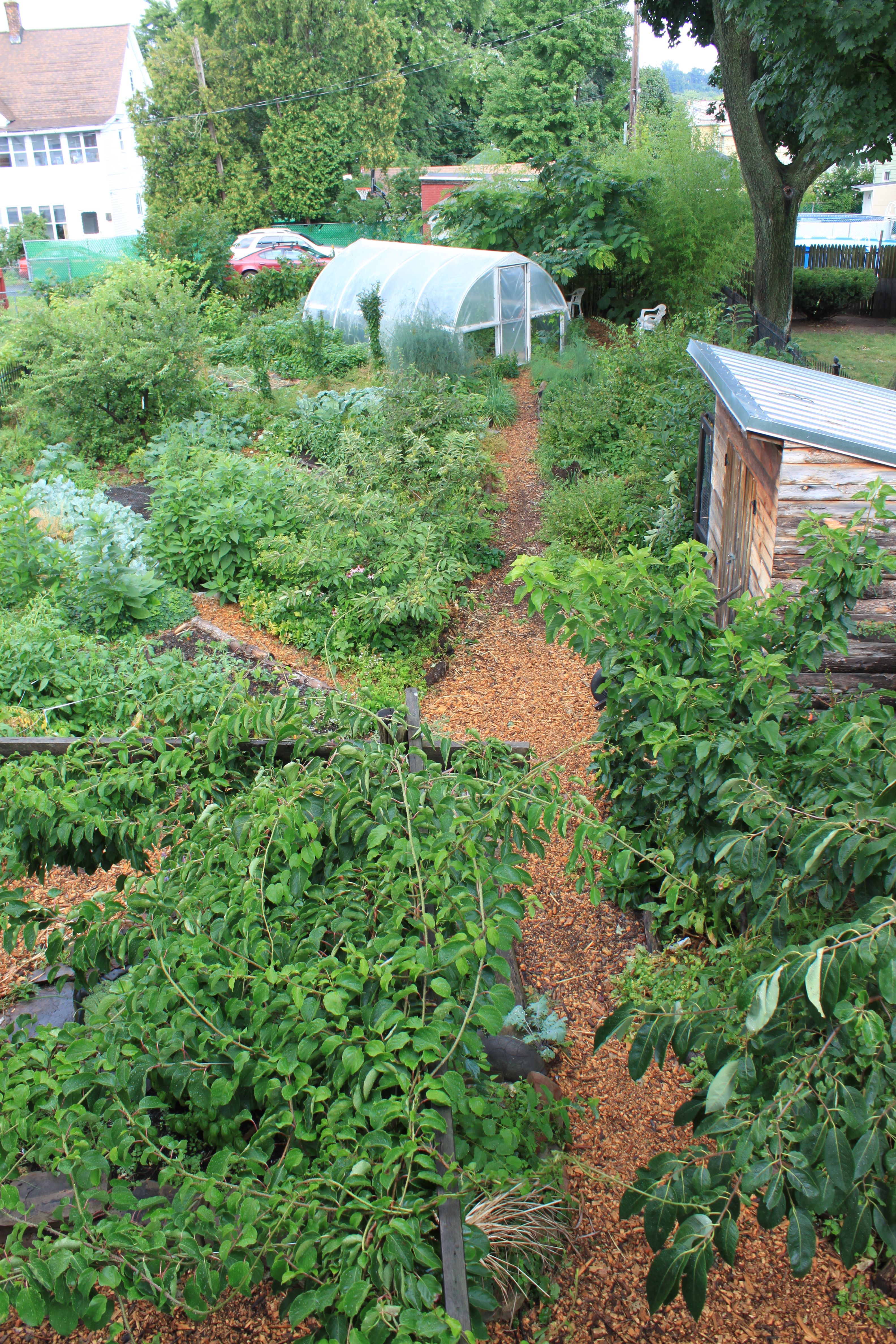
My yard Toensmeier's yard

My project took place in Portland OR, his on the other side of the continent in Holyoke MA. My lot was two tenths of an acre, his lot half that. But besides differences in space for trees, and somewhat different plant palettes, Eric Toensmeir's account in Paradise Lot of applied permaculture reads like a parallel universe of my own experimentations with urban lot rehabilitation and perennial polycultures. We each started with infertile and unpromising soil, but guided by permaculture literature from other regions and with the help of gardening partners (romantic in my case; friend Jonathan Bates in his), we embarked on labors of faith towards similar goals of abundant food production and restored habitat health.

And we both succeeded. I've documented most of my experiments, successes, and failures on this blog. Toensmeier has shared much of his plant knowledge, from which I've drawn heavily, in the appendices of Edible Forest Gardens: Volume Two (coauthored with Dave Jacke), his book Perennial Vegetables, and his DVD Perennial Vegetable Gardening. But besides early site analysis in Edible Forest Gardens, a few video clips from garden tours, and the Apios Institute wiki behind a paywall, we haven't gotten many details on the overall transformation of his lot or on his polyculture explorations. Paradise Lot provides a fairly thorough account of how Toensmeir and Bates selected, analyzed, amended, sheet-mulched, planted, and enlivened their site. Though the theoretical process is well described in various forest gardening books, it doesn't hurt to have another case study providing specific details of how a site plan can evolve over the years.

Many individual species are briefly described, without many surprises for those who have already devoured references like Perennial Vegetables and Martin Crawford's Creating a Forest Garden. Most exciting for me is Toensmeier and Bates covering new ground with perennial polycultures (literally). It seems they encountered many of the same challenges I had with perennial polyculture design, especially from lack of hands-on experience growing and using individual species. It's difficult to assemble successful mixes without intimately understanding the life cycle, growth habits, and harvest season of each component. Amusingly, they created a hog-peanut/gooseberry mess similar to, though not as bad as, my infamous gooseberry/stinging nettle polyculture. A great example of why we need to share information about what works and what doesn't, to reduce effort wasted on demonstrably bad combinations!

Disappointingly, the book ends before Toensmeier has had a chance to develop many successful polycultures, similar to my timing of moving before getting to implement my own new perennial polyculture designs. Even so, there are some succesful polycultures and further hints and lessons in the book. Notably, he arrived at the same conclusion I did: low, spreading groundcovers are critical components. He describes success with some strawberry species, a violet, and some native plants, but without many details beyond that of what specific crops to fit together.

I find it very promising that we achieved similar positive results in fairly different climates. We both successfully rehabilitated trashed urban lots into land that could support both humans and non-humans. We both, through the simple techniques of heavy mulching to build soil and planting a wide variety of perennials, created habitat for greater numbers and species diversity of insects, birds, and other life. By selecting mostly edibles for our plantings, we both wound up with abundant harvests of low-maintenance perennial vegetables. (And we both had a shortage of perennial greens in the summer; apparently this has more to do with the life cycles of perennials than with the summer drought of the Pacific Northwest.) We both had similar success allowing natural predators to handle pest outbreaks. We both put a lot of time up-front into planning and design, but both made lots of mistakes easily avoidable by others learning from our examples, so I feel pretty confident that our achievements are replicable by anyone who takes this approach with even a minimum of planning and research.

I felt surprised by how much focus Toensmeir put on nitrogen-fixers, as I realized a couple years into our endeavour that one person's urine fertilizes 4000-5000sf of forest garden, the size of their entire lot. Despite cycling the urine from four adults into the yard, Toensmeier is still carefully planning N-fixing plants at the end of the book. Perhaps they all spend so much time off-site that they can't capture enough urine, or perhaps Toensmeir never thought to calculate this?

The book also features a strong subplot of the two bachelors hoping to attract mates, with as much success as in their gardening! Personally, I was much more interested in the plant-geek narrative, but I'm sure many readers will appreciate the human interest story balancing out the site analysis and gardening.

Toensmeir explores some of the dynamics of the neighborhood, the town of Holyoke, and the even broader community. I found his vague hope of inspiring change through personal example to be unconvincing. I'm fairly jaded by my own experience in Portland attempting to model something approximating urban self-sufficiency and sustainability: not only were our inputs of free wood chips and dumpstered waste streams unscaleable to more than a small fraction of the entire city, and not only did I conclude that Portland would have to kick out half the population even in a wildly optimistic scenario of everyone doing a better job than we'd managed, but only a handful of the people who toured our yard actually adopted perennials to any great extent. So I'm pessimistic (or realistic) about the inability of cities to ever support their populations in any sustainable manner.

But that's fairly tangential to the main focus of the book, and certainly anyone interested in urban, suburban, or rural zone 1 and 2 gardening can and should learn from this case study. It's a quick, fun, and relatively light read. Enjoy!

Tuesday, December 09, 2014

Shading paths in Hawai'i

This post follows up on the concepts of my post Sun and Shade, Temperate vs Tropical, with some quick thoughts on paths. Ideally, Hawaiian paths would be shaded in the summer for protection of humans from the sun and maximum photosynthesis, but more open in the wet winters to prevent too much mud and muckiness.

Paths running east-west could have large trees planted on the north side to overhang the path enough to provide shade from the spring to fall equinox, while allowing winter sun to enter from the south.

Paths running north-south could be treated in one of a few ways:

  • Compromise plantings of hedges or trees at wide enough spacings or with relatively sparse canopies to provide incomplete summer shade and incomplete winter sun.
  • Coppiceable plantings of quick-growing trees or tall hedges, cut in the winter and allowed to grow through the summer. This would work well with N-fixers to provide mulch easily transported along the paths to desired destinations.
  • Deciduous plantings (such as kapok) providing the standard summer shade/winter sun service.

Friday, November 07, 2014

Resistance review: The Effectiveness of Sabotage

I just had a short essay published on a 1987 thesis by Captain Howard Douthit III of the US Air Force: “The Use and Effectiveness of Sabotage As a Means of Unconventional Warfare.” The thesis is a great review of the historical use of sabotage and its impressive success, especially in asymmetric conflicts. This helps validate the wisdom of the Deep Green Resistance Decisive Ecological Warfare strategy for achieving environmental and social justice. From the thesis:

The only countermeasure that stopped sabotage was the manpower-prohibitive act of exterminating the saboteurs. Committing the number of forces necessary for effective counter-sabotage also produced too much of a drain on the front line. Indeed, as this fact became known, sabotage efforts increased in a deliberate move to force the enemy to guard against sabotage in the rear area. Thus, this research indicated there were no effective countermeasures to sabotage.

[...]

[H]istory supported the thesis that sabotage is an effective means of warfare. Sabotage was used against both strategic and tactical targets. It was proven capable of being used near the front line, in the rear areas, and even in support areas out of the theater.

[...]

Sabotage can be used against both tactical and strategic targets.

Any nation, rich or poor, large or small can effect sabotage against an aggressor.

Sabotage is an economical form of warfare, requiring only a mode of transportation (possibly walking), a properly trained individual, and an applicable sabotage device.

Read my entire essay, with links to the DGR strategy and to Captain Douthit's paper, at Time Is Short: The Effectiveness of Sabotage.

Sunday, October 12, 2014

Direct action land reclamation

A Deep Green Resistance supporter sent a link to a photo essay he compiled about Occupy the Farm in Albany, CA. A group of local residents, activists, and university students blockaded destruction of the last prime soil in the city, destined to be wiped out for, ironically, a Whole Foods Market.

This is a great example of direct action to preserve land from development and to spotlight the need for growing food locally in urban areas. Read the whole article: These People Faced Down Riot Cops to Grow Food: Here's How They Won.

Monday, October 06, 2014

Business As Usual: The False Solutions of Green Tech

My readers in the Portland area may be interested in attending one of the upcoming presentations by Deep Green Resistance Lower Columbia in Hood River, Albany, and Vancouver WA, on "Business As Usual: The False Solutions of Green Tech." Make it if you can; DGR has some unique and valuable insights to offer in the fight for a livable planet.

Thursday, September 25, 2014

Review of Open Sesame: The Story of Seeds

I wrote a review recently of the documentary Open Sesame: The Story of Seeds. I found a lot to like, but coming from permacultural and radical environmental perspectives, I ultimately felt disappointed that the film didn't take on more than it did.

The film shows beautiful time lapse sequences of seeds sprouting and shooting into new life. Even rarer, it shows people feeling very emotional about seeds, displaying extra-human connections we normally only see with domesticated pets, and hinting at the human responsibility of respectful relationship with all beings described by so many indigenous people. The movie highlights great projects from seed schools and the Seed Broadcast truck educating people on why and how to save seed, to William Woys Weaver and others within Seed Savers Exchange doing the on-the-ground work of saving varieties from extinction, to Hudson Valley Seed Library trying to create a viable business as a local organic seed company.

Unfortunately, Open Sesame has an extremely narrow focus. Though it rightly brings up the issue of staple crops, which many people ignore in their focus on vegetables, it trumpets our dependence on grains, even showing factory farmed cattle, pigs, and chickens in an uncritical light. This assumption that humans need annual crops reveals an ignorance of agriculture itself as a root cause of our converging environmental crises. Even before industrialism accelerated the destruction and oppression, civilization and its cities, fed by organic agriculture, was eroding soil, silting up waterways, turning forests into deserts, and instituting slavery and warfare. Though the diminished diversity within our food crops should indeed cause concern, the far greater biodiversity loss of mass species extinctions under organic agriculture should spark great alarm, if not outright panic.

[...]

Though the documentary chose not to tackle those big-picture issues, it still could have included perennial polycultures, groups of long-lived plants and animals living and interacting together in support of their community. For 99% of our existence, humans met our needs primarily from perennial polycultures, the only method proven to be sustainable.

Read the entire review of Open Sesame at the Deep Green Resistance News Service.

Thursday, July 17, 2014

Hoophouse on the Slug Moat

In fall of 2011 I built our slug moat to protect nursery pots from slugs while providing rainwater catchment and other typical aquatic benefits. A few months later, to prepare for spring and make the most of the contraption, I added a hoophouse over the nursery table to provide a warmer, protected microclimate for the plants, without interfering with the use of the pond as an irrigation source.

Duck Integration

I wanted ducks to use the pond, but knew that with unrestricted access they would trash such a tiny area, destroying all plants and fish and filling the pond with poop and stirred up muck. To exclude ducks from enough of the pond to allow sheltering of fish and growth of poop-filtering cattails, I put a fence across the middle of the pond and around the excluded perimeter. Ducks could still be allowed into the protected area periodically, under close supervision.

I constructed a little ramp to make it easier for the ducks to get in and of the water.


Skirting

Using thin plastic which had wrapped our lumber deliveries, I constructed a skirting sandwiched onto the table sides and posts with lathe and hanging to the water below. I hoped this would create a lower seal preventing air from coming up into the nursery table.

Hoophouse

Next, I built a ventable upper enclosure for the plants from clear vapor barrier plastic left over from the house project. I created the end "wall" closest to the house by rolling a piece of lathe into a short piece of plastic, clamping it closed with three strong binder clips. I secured the lower half of this plastic to the vertical posts with more lathe, and tacked a couple of nails into the posts to allow the wall to be "hung" up for closure, or unhooked from the nails to half-open that end of the hoop house.

Since I didn't have posts to work with at the far end of the table, I used a single large piece of plastic for the rest of the hoop house, supported by plastic hoops screwed to the sides of the table, and draping down as the far wall. I used more binder clips to seal the junction between the large piece of plastic and the end wall, unclipping as necessary to move the sheets for ventilation.

I secured the sides by creating a small gap between the existing pallets on top and new wood I attached to the table sides just below. Tucking the plastic into the gap and wedging in some lathe created a strong seal, while allowing easy access or ventilation of the sides by pulling out the lathe.

Successes

On the whole, it worked. It definitely created a warmer microclimate and allowed faster early spring growth of the plants. Using all scrap materials, it had a distinctly amateur look to it, but was fairly easy to use for ventilating and accessing plants. I'm especially pleased with the side attachments of wedged lathe, which worked surprisingly well.

Problems

Despite lathe sandwiching it to the posts as low as possible, the lowest part of the skirting, pushed outwards by the concrete pier blocks, tended to blow around, failing to make a reliable seal. Often the skirting got stuck on the perimeter fence, potentially negating the slug-proofing function of the slug moat. The plastic scrap I used was just barely long enough to reach the water surface; with more material to work with I could have wrapped the bottom with some weights to ensure a straight drop to the pond.

The cross fence within the pond was of very flimsy construction and even flimsier attachment. A fence could have been secured to two of the table legs and anchored against their concrete piers stacked in the water below, but the placement of the table within the pond didn't make sense for that. It would have created either too tiny a pond for the ducks to use, or too small an area for plants to grow without duck disturbance.

The perimeter fencing, secured very loosely with metal stakes salvaged from political yard signs, also failed to inspire confidence. Neither the perimeter nor the internal fence were tested long-term against inquisitive ducks, and I suspect both would have required some adjustment and fiddling.

The binder clips came loose easily from slippery plastic, both where I wrapped lathe into the plastic to create the end wall and especially where I tried to clip the two upper sheets together. Again, I was using pieces just barely long enough to meet, so any significant wind put a lot of force on the joints. Slightly longer pieces with more overlap and slack would have helped. Ultimately the system needed a better connector - perhaps snap-on grommets.

Saturday, July 12, 2014

Perennial Greens Planting Plan

Zone 1, extending into zone 2. From bottom center, working counter-clockwise:
Giant sea kale, sweet cicely in seed, turkish rocket, zebra mallow in flower, perennial kale in seed, lemon balm, french sorrel in seed, borage in flower, elephant garlic in flower, sylvetta arugula in flower, and nipplewort.
Also skirret & chinese dogwood in background, with crocosmia in foreground.

Two mistakes I made in my perennial vegetable experimentations in Portland:

  1. I overplanted perennial greens, more than we could possibly eat.
  2. I planted the greens over a large area, forcing more traversal of the yard than necessary. Though walking the yard to pick greens helps keep an eye on everything, it's inefficient to go further than necessary on a nearly daily basis.

Before we sold the house, I was consolidating a core set of perennial greens into approximately 100 square feet of beds closest to the house. This brought the front yard garden into better alignment with design by zones, with a tight zone 1 producing the majority of the daily pickings for two adults (leaves & flowers, salads & cooked), and freeing up zone 2 for root crops and less frequently harvested vegetables. I still envisioned picking from zone 2, from deliberate plantings and from edible weeds, a few times a week for variety and to augment zone 1 production.

This design took advantage of the fact that, for much of the year, the house shades most of the front yard area closest to it (especially after we raised the house 3'.) Most of the perennial greens should do well in partial to full shade, whereas the root crops and annuals generally need more sun. Most herbs also want full sun, and we found we didn't need to pick them with each batch of greens, so the larger ones made more sense for us in zone 2.

Writing this up two years later, I don't remember the exact number of which plants I moved into zone 1, but I believe I've come close below. It's a good starting point; you'll need to experiment anyway with what works well in your site and what you like to eat. Regardless of the exact species composition, the end result of densely planted perennials should be a yield of greens requiring little to no work besides harvest - more or less no need to dig soil, replant, or weed. (And year-round, at least in Portland and similarly mild winter climates.)

Large Plants

Usually planted 2-3' apart. You can perhaps get away with closer spacing in a heavily harvested zone 1, but I'd be inclined to still give them full spacing.

QtyLatin nameCommon name
1Agastache foeniculumAnise hyssop
1Brassica oleracea acephalaTree collards
3Brassica oleracea acephala'Western Front' perennial kale
1Crambe cordifoliaGiant sea kale
2Crambe maritimaSea kale
1Foeniculum vulgareFennel
2Malva sylvestris mauritianaZebra mallow
1Malva moschataMusk mallow
2Melissa officinalisLemon balm
1Myrrhis odorataSweet cicely
2Rumex scutatus or R. acetosaFrench Sorrel
6 sfScorzonera hispanicaScorzonera

Groundcovers

These can be planted under and around the large plants, to exclude weeds and provide bonus greens & flowers.

Latin nameCommon name
Barbarea vernaWintercress
Campanula portenschlagianaBellflower
Campanula poscharskyanaTrailing bellflower
Claytonia montiaMiner's lettuce
Claytonia sibericaSiberian miner's lettuce
Diplotaxis tenuifoliaSylvetta arugala
Origanum sppOregano species
Oxalis oregonaRedwood sorrel
Rumex acetosellaSheeps sorrel
Sanguisorba minorSalad burnet
Stellaria mediaChickweed
Taraxacum officianaleDandelion
Thymus sppThyme species
Viola sppViolets

Bed Edges

We used a lot of Allium greens, finding them much easier to grow than bulbing onions. These work well along the edges of beds, helping delineate the pathways.

Latin nameCommon name
Allium ampeloprasumElephant garlic / Leek
A. cepa 'proliferum'Egyptian walking onion
Allium cernuumNodding onion
Allium fistulosumBunching onion
Allium sativumGarlic
Allium schoenoprasumChives
Allium tuberosumGarlic chives

Zone 2 Greens

If you have more room available, I would experiment with these. For species already listed above, numbers given are in addition to the quantity in zone 1. These are just for greens and flowers; not considering root and seed harvests of things like yellow asphodel and good king henry.

QtyLatin nameCommon name
1Agastache foeniculumAnise hyssop
5Anthriscus sylvestrisWoodland chervile
2Aquilegia vulgarisColumbine
4Asphodeline luteaYellow asphodel
2-3Bunias orientalisTurkish rocket
4Campanula rapunculoides, C. persicifolia, and other tall speciesBellflowers
10Chenopodium bonus-henricusGood King Henry
2Crambe maritimaSea kale
1-2Foeniculum vulgareFennel
1Levisticum officinaleLovage
1Lycium barbarumWolfberry
6sfMentha spicataSpearmint
1-2Myrrhis odorataSweet cicely
3-4Oenothera biennisEvening primrose
3Rumex scutatus or R. acetosiaFrench sorrel
2Smyrnium olusatrumAlexanders
1Symphytum officinalisComfrey
10sfUrtica dioicaStinging nettles

Zone 2 Stems & Shoots

Other vegetables nice to grow for something other than greens and flowers.

Latin nameCommon name
Arctium lappa or A. minorBurdock
Asparagus officinalisAsparagus
Maianthemum racemosumFalse solomon's seal
Petasites frigidusSweet Coltsfoot
Petasites japonicusFuki
Polygonatum biflorum and P. commutatumSolomon's seal
Rheum x cultorumRhubarb

Zone 2 Weeds

Volunteers that often need to be kept in check. We generally ate these rather than weeding per se.

Latin nameCommon name
Borago officinalisBorage
Calendula officinalisCalendula
Cardamine unknownPopweed
Geum urbanumClove root
Lamium purpuruemPurple dead nettle
Lapsana communisNipplewort
Phytolacca americanaPokeweed
Solanum nigrumBlack nightshade
Taraxacum officinaleDandelion

Thursday, June 26, 2014

Bluehost subdomain for WordPress Multisite domain mapping

This is a geek-post, unrelated to permaculture or resistance. I couldn't find this information when trying to set it up, so wanted to document it here.

There are some guides (try here and here and here and here) to configuring the WordPress MU Domain Mapping plugin, but they don't address Bluehost specifically, and several of them refer to using cPanel to Park Domains, creating wildcard subdomains, registering a domain specifically to handle multisites, moving your domain website into a subfolder to use the root folder for the multisites, and so on. I think I found a simpler way.

Bottom line: it is possible, on Bluehost, to use a subdomain of your domain to host a WordPress Multisite Network, and you can set it all up in any subdirectory so it doesn't interfere with your regular domain. The multisites can be mapped to any domains or subdomains you own. You don't need to register a separate domain or change your existing file structure.

I won't try to recreate a guide for the steps to install WordPress multisites, the Domain Mapper plugin, or how to configure them for general use. I'll just lay out the important points related to configuring as described above. I'll use "mydomain.com" as the domain you already have.

Basically we're going to point all domains and subdomains to a single multisites subdirectory containing the WordPress multisite install, and then tell the Domain Mapping plugin how to sort everything out:

  1. In cPanel->Domain manager->Subdomains, create a subdomain such as multisites.mydomain.com and set the Document Root to something like /public_html/multisites
  2. Install WordPress Multisites on the new subdomain, using the subdirectory method for separating sites, not the subdomain method. So it'll create http://multisites.mydomain.com/site1 http://multisites.mydomain.com/site2 http://multisites.mydomain.com/site3 etc
  3. Install the domain mapper plugin
  4. For any domain you want to use with the Multisites Network, in cPanel->Domain List, set the domain as an Addon using the /public_html/multisites directory. For example, you may have myseconddomain.com as an Addon, using /public_html/multisites as its directory. cPanel seems to require that you also create an alias subdomain from your primary domain pointing to this addon. It shouldn't matter what you call it. You could use seconddomain.mydomain.com
  5. For any subdomain you want to use with the Multisites Network, in cPanel->Domain Manager->Subdomains, create the Subdomain using the /public_html/multisites directory as the Home folder (aka Document Root.) If a subdomain already exists and you want to change the Document Root, Remove and recreate it.
  6. In your Multisite install, from My Sites->Network Admin->Sites, "Add New" site for each domain or subdomain. It doesn't really matter what directory name you specify for the Site Address.
  7. In the Domain Mapping plugin, accessed either from Network Admin->Settings->Domains or from a Subsite->Dashboard->Tools->Domain mapping, add each domain and/or subdomain you want to use with the site. Set the desired one as "Primary". You should wind up with something like: http://myseconddomain.com (Primary), http://seconddomain.mydomain.com, and http://multisites.mydomain.com/site1

Now when you access the site from http://seconddomain.mydomain.com or http://multisites.mydomain.com/site1, it should redirect the browser URL to http://myseconddomain.com (whatever you set as Primary).

I did run into a problem with a domain I was transferring from another registrar, that I already had set up in the Domain Mapping plugin, but wasn't being picked up properly. I think I had to remove and re-add the domain name within the Domain Mapping area to get it to work.

This will leave you with a WordPress site at http://multisites.mydomain.com which I don't think you can map anywhere else. You can either use the site for something serious, use it as a placeholder to link to your various sites, or update the sample post to say "Ignore this site." and set it so that search engines don't index it.

Feel free to ask questions in the comments, but I can't guarantee that I'll respond. Tech support on this is not a priority for me. Sorry!

Sunday, June 08, 2014

Book Review: Assata Shakur: an Autobiography

I greatly enjoyed this book and Assata Shakur's writing, and have great respect for what Shakur has gone through and the lessons she's learned and shared. I posted a review at the DGR Hawaii site, comparing her life as a poor black woman to my own as a middle class white male, and drawing parallels between her political analysis and that of Deep Green Resistance. Read my review of Assata: An Autobiography.

Wednesday, June 04, 2014

Video review: Sophie Scholl - The Final Days

I've started a blog for Deep Green Resistance Hawaii, and will probably post most resistance-oriented stuff there, and continue to use this blog for permaculture related and personal posts. But I'll also post here when I think I've made posts of interest over at DGR Hawaii.

I just posted a short review of Sophie Scholl - The Final Days. I watched it last night, and found it educational for those interested in building a culture of resistance, and think it will appeal to a more general audience as well. The acting is excellent, and it's well done overall. Check out my review and the movie if you have any interest in historical documentaries and/or Nazi Germany.

Tuesday, May 27, 2014

Self Sufficiency, Five Years In on youtube

After many failed attempts with other software, I used Windows Movie Maker to create a video version, now on youtube, of my Self Sufficiency, Five Years In slideshow. I've updated my main post with various links to the presentation.

Monday, May 19, 2014

Sun and shade, temperate vs tropical

May has arrived in Hawai'i, and for the next two months, the sun will shine on us from the north. Huh? From the north? Doesn't that only happen in locales south of the equator, like in Australia?

(The rest of this post assumes a northern hemisphere location, expecting the sun to shine from the south.)

I knew the sun travels at a higher angle in the tropics, and I knew that in temperate climate summers the sun rises and sets in the north. But until shortly before moving here, I had no idea that for part of the summer, our sun never even crosses over to the south. This is the case everywhere within the tropics; on the margins, the Tropic of Cancer and the Tropic of Capricorn, the sun is directly overhead at noon on June 21st. Closer and closer to the equator, the sun spends more and more time in the north, with part or much of the summer never even seeing the sun shine from the south. This makes for a bizarre solar chart!

Combined with greater tropical sun intensity and temperatures, this necessitates different strategies for shading structures. Standard temperate tricks for winter sun/summer shade don't directly apply; properly sized and angled eaves, deciduous vines on a south arbor, and a deciduous tree to the southwest don't help when the midday sun is directly overhead or shining from the north. I'm no expert at this for Hawai'i, let alone qualified to generalize to the rest of the tropics, but here are my observations and thoughts so far. Some of this also applies to plant interactions and light into understories.

  • It's not nearly as important to maximize sunlight in the winter. Though it helps combat the mildew and mustiness we encounter in this super-rainy part of Hawaii, we don't need the sun for warmth. It's OK to compromise a bit on winter sun access.
  • We don't need to design for morning sun. Unlike temperate climates, where it can still be chilly on spring, fall, and even summer mornings, we don't need a quick boost of morning sun to warm us up.
  • We don't have a large choice of trees that drop their leaves in the winter, and I have even less knowledge of exactly when they drop and regrow leaves, or whether they stick to a consistent schedule driven by the sun (rather than, for example, rainfall.)
  • We don't have many deciduous vines. The best I've found so far are the yams (Dioscorea spp.), of which the winged yam (D. alata) and air potato (D. bulbifera) seem most useful. They die down to the ground in November or December, and resprout in March or April, growing quickly to potentially cover a large area by early to mid summer. These may work well growing directly on top of the roof, or on a framework trellised over the roof.
  • Rather than a tree to the southwest, we want trees to both the east and west, or the northeast, north, and northwest. Ideally we'd have full tree canopy directly over the structure and maybe a bit to the south. This would provide full winter sun with maximum summer shade. An ideal tree, in order of priority:
    • Has a broad, spreading canopy of known width so we can plant it reasonably far from the structure and not have to prune too much
    • Produces some useful yield of fruit or leaves suitable for zone 1, perhaps harvestable from the roof
    • Doesn't drop limbs or large fruit on the roof (or loud hard nuts on a metal roof)
    • Grows to a useful size quickly, then slows down
    • Doesn't drop much leaf litter, especially if the roof is used for rainwater catchment
    • Lives a long time
    • Does not fix nitrogen, since we'll already provide ample urine to the area

I need to do more research on possible tree candidates, and probably some experimentation to figure out which will grow well on our particular site once we settle somewhere. I'll share those thoughts once I've developed them further!

Wednesday, May 07, 2014

Integral Permaculture presentation on "Food Freedom"

Integral Permaculture, a radical permaculture group, put together "Food Freedom: an Integral Perspective", a talk for International PermaCulture Day. They cover:

  • The food freedom of other species
  • The food that most liberates our environment
  • Food that liberates the human mind and body
  • How not to be enslaved to addictions
  • How to free our meals & economies from the Multinationals

Watch the recording of Part 1, and the upcoming Part 2 on Sunday May 11th, at Integral Permaculture Food Freedom.

Tuesday, April 15, 2014

Hymenoptera - from oasis to desert

A lot of the permaculture literature praises parasitic and predatory wasps in the garden, where they keep insect populations balanced. If a certain "pest" insect becomes too abundant in your wasp-friendly garden, the chances are good that predators will find that abundance, feast away, and bring the prey numbers back down to an unproblematic level. Bees, Wasps, and Ants by Eric Grissell goes further into the amazing lives of all the Hymenoptera, paying special attention to parasitic and predatory wasps. The book gives lots of gory details, and even the non-gory bits are generally more than one strictly needs to know, but it's fasinating if you're into that sort of thing. It's re-inspired me to take a closer look at flowers and who's around.

In my Portland garden, I saw increasing numbers of individuals, and entire new species of bees and wasps every year. Permaculture sources recommend scattering beneficial insectary plants throughout your garden, especially plants in the carrot (Apiaciae), sunflower (Asteraceae), and mint (Lamiaceae) families. Our success in attracting so many insects to our old garden probably lies in our planting 50+ species of perennial flowering plants, ensuring a yard full of blooms from early spring to late fall. (Also, we didn't "clean up" the garden over the winter, instead allowing dead stalks and ground litter to provide overwintering shelter.) Our reliance on perennial vegetables effortly provided food to our insect friends, an important benefit alongside the near elimination of our need to tend the garden and of soil disturbance. I'm concerned that as people maximize food production within cities, they'll convert ornamental plantings to annual vegetables and starve out the insects. Besides the loss of "pest" control provided by wasps, cities could lose honey production as bees lose their foraging grounds. And of course, these insects have every right to live and exist for their own sakes, regardless of any benefit to us. For this and many other reasons, I strongly advocate perennial vegetables, shrubs, and trees as the backbone of any food system.

Sadly, Hawaii has been something of a shock. Apart from a diversity of ants (no species of which occurred in Hawai'i before European arrival), the Hymenoptera we've seen to date are Sonoran Carpenter Bees (lots), honey bees (rare), a stinging paper wasp (a few times - generally accompanied by shrieks), yellow jackets (once, at the Volcanoes National Park), and maybe I saw a small green bee on a flower once. This paucity in biodiversity, unfortunately typical of my experience here thus far, could result from the GMO Papaya Fields of Death in the neighborhood, the general oddness and artificial simplicity of this island ecosystem heavily reshaped by humans, and/or the lack of flowers around here. I'm hoping the latter, as we could rectify this with plantings.

We don't have many flowers here period, and of those present, most are deep, suited to birds, large bees, and large wasps, but not so much to smaller bees and wasps, especially the parasitoids. Grisell reiterates the importance of the sunflower, carrot, and mint family flowers, then writes:

"Bees and wasps come in a huge array of different shapes and sizes. Some have long tongues, others have short ones. Thus, the more shapes of flowers found in a garden, the more and different kinds of hymenopterans will be attracted. Even within a single group such as bumble bees, there are long-tongued species that can reach directly into the nectar spur of a tubular flower such as a columbine, whereas short-tongued species will simply bite a hole at the base of the tube to reach the nectar. Most bees apparently prefer bilaterally symmetrical flowers, by which they orient themselves and then enter the flower's throat. Shallow, dish-shaped flowers, such as apple or blackberry, which are radially symmetrical, are called open-access flowers because many different sorts of insects, including Hymenoptera, have access to the nectar."

Grissell explains the role of color and scent in attracting pollinators, then concludes:

"Creating a garden that enhances the likelihood of attracting adult bees, predatory wasps, and parasitic wasps merely requires that it be a garden of diversity. To achieve diversity, a garden must have many different kinds of plants including native and cultivated species; flowers of different sizes, petal count, shapes, colors, and seasonality; and integration of plants into a network that attracts so much biological diversity that attacks on its structure are absorbed with scarcely a notice by the gardener."

We've noticed, on this land and on other farms and homesteads, a near complete disregard for tree and orchard understories, where most of this diversity can take place. We hope to find many suitable understory plants and arrange them into functional polycultures, but for now we mostly have just theoretical ideas.

We did notice a pretty little insect on the pretty little flowers of Ageratum conyzoides, in abundance around here as a weed. I thought at first that it may be a small bee, but after a good look we suspect a fly of some sort. (UPDATE: thanks to BugGuide.net, I've identified this as a male syrphid fly, Toxomerus genus, probably T. marginatus) Still, I appreciate the prompting of Bees, Wasps, and Ants to look at our smaller neighbors, of whatever orders!

Sunday, April 13, 2014

Self Sufficiency, Five Years In - audio slideshow

In spring 2011, I gave a presentation three times on the progress, successes, failures, and lessons from five years of working towards self sufficiency with my ex-partner at our house in Portland. I advertised the event with this blurb:

In March of 2006, Tulsi and Norris purchased a small house on a .2 acre lot, and used permaculture principles to design their food forest, sun garden, and house renovation. They aimed to create a low-maintenance, truly sustainable habitat for 2-4 people plus wildlife, providing from the property all necessary food, heating & cooking fuel, water, and waste treatment. Join us for a reality check on what's worked and what hasn't, what seems theoretically possible for the future, and what all this means to the oxymoronic goal of a sustainable city.

I've finally synced up an audio recording I made of my presentation with the slide images, to make a sort-of movie. You can view the Self Sufficiency, Five Years In slideshow online (may require reasonably fast internet connection) or download a 36MB zip file for offline viewing. (Extract to anywhere on your hard drive, then open the included index.html file in your web browser.)

I've also created a video, which requires more bandwidth: Self Sufficiency, Five Years In on YouTube. (You can download the 166MB WMV movie file or watch it below)

Or you can download a 6 MB PDF of the slideshow without audio.